Snapshot of History
PROTECTED CONTENT
If you’re a current subscriber, log in below. If you would like to subscribe, please click the subscribe tab above.
Username and Password Help
Please enter your email and we will send you a password reset link.

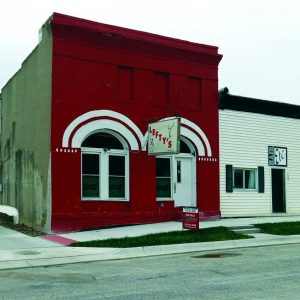
Rideta Electric Cooperative building on August 3, 2013.
BY MIKE AVITT
The REC building is located at 1502 W. South Street in Mount Ayr. But, I just learned, the current name of the outfit is Southwest Iowa Rural Electric Cooperative. This building was erected in 1975-76 by Roe Implement.
Two events took place in 1945 that resulted in a business boom for Ringgold County: the end of World War II and the implementation of rural electricity. Farms were more productive, hundreds of jobs were created, and electric appliances sold faster than the retailers could order them.
It started on May 11, 1935 when then U. S. President Franklin Roosevelt signed an executive order which created the Rural Electrification Administration. Plans to electrify rural Ringgold County began in 1940 but World War II pushed it back to 1945. That’s when, on April 9th, Rideta (RInggold, DEcatur, and TAylor counties) Electric Cooperative President, C. C. Brimmer, released voltage to 58 customers on 30 miles of line through an electrical substation at Knowlton. The plan was to add twenty miles of line per week.
An article in the May 12, 1960 Mount Ayr Record-News gives a little history and updates concerning REC. Eldon Main was the president in 1960 and there were twelve employees. REC was formed in 1940 and was approved for loans by the REA in 1941. REC was first located in the post office basement, then at 120 W. Madison from 1941 to 1944, and finally in their long-term home at 111 S. Fillmore in July 1944.
By 1960, REC had paid back 600,000 dollars of a 1.8 million dollar loan and was operating on 1,087 miles of line. I don’t know when they moved to their current location.
In 1945, when electricity came to rural southern Iowa, most of the county trunk roads were graveled. Farmsteads were improved with deep-freezers, fans, refrigerators, lights, and radios. But, also with milking machines as barns got electricity.
Remember, the rural population was quite high in 1945 so radios sold by the thousands and even filling stations and shoe repair shops were selling radios. Television became popular around the mid-1950s.
Auto dealerships and farm implement businesses began selling larger appliances like deep-freezers and refrigerators. Electricians were in high demand. Electrical and plumbing supplies sold rapidly. The boom lasted many years as electrical appliances improved and items such as air-conditioners and television sets became more affordable.
Everything depends upon electricity whether we want it to or not.