Extreme drought creeps into southern Iowa
PROTECTED CONTENT
If you’re a current subscriber, log in below. If you would like to subscribe, please click the subscribe tab above.
Username and Password Help
Please enter your email and we will send you a password reset link.
By Jared Strong
Iowa Capital Dispatch
Dry conditions in Iowa are continuing to worsen as the state’s corn crop nears peak demand for water. About 83% of the state is suffering from some degree of drought, according to a Thursday report by the U.S. Drought Monitor. That’s up from about 68% the week before. And the total area that has “extreme” drought — the second-worst classification used by the Drought Monitor — more than quadrupled since last week.
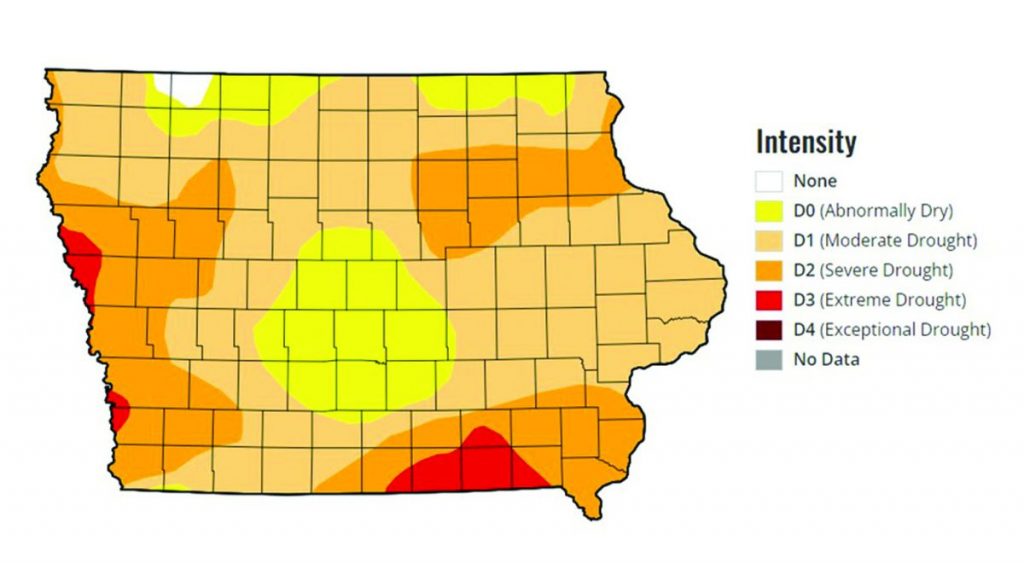
That level of dryness has for months been relegated to an area near Sioux City. There is now a pocket of extreme drought near Council Bluffs in southwest Iowa, and a wider swath has developed near the Missouri border in southeast Iowa.
“We’ve just been stuck in that stagnant, high-pressure, omega blocking,” State Climatologist Justin Glisan said of the gargantuan atmospheric condition centered over southern Canada that has been disrupting the northern hemisphere’s jet stream for weeks.
“It just backs up the entire west-east flow and, hence, rapid-onset drought across the state,” he said.
The total area of the state suffering from drought has more than tripled in the past month, though wetter days are predicted to lie ahead. The questions is: when?
“You have to shake this configuration at some point,” Glisan said. “The storm track that we’re seeing this weekend, and then the shorter-term outlooks, are suggesting that within the next several weeks we should see a shift.”
Iowa’s drought is the worst it’s been at this time of the year in more than a decade. The overall dryness is comparable to 2021, which trended wetter as that year progressed.
Timely rains in 2021 led to highest average corn yields ever in Iowa, at 204 bushels per acre.
In 2012, which had the worst yields by far of the past two decades, the overall dryness of the state was much better in June, but conditions quickly deteriorated into one of the worst droughts ever recorded for Iowa.
Right now there is a small area of far northwest Iowa that has normal soil moisture, in Dickinson and Osceola counties. Only 30% of the state’s topsoil has adequate moisture for crops, the U.S. Department of Agriculture reported this week, and crop conditions have been declining.
Corn’s water usage typically peaks in July as the plant develops a tassel to spread pollen.