Snapshot of History
PROTECTED CONTENT
If you’re a current subscriber, log in below. If you would like to subscribe, please click the subscribe tab above.
Username and Password Help
Please enter your email and we will send you a password reset link.
BY MIKE AVITT
Many of you have heard Jesse James and his gang spent time in Ringgold County. Many of you believe it. I don’t. But, I’m about to tell you why you heard it in the first place.
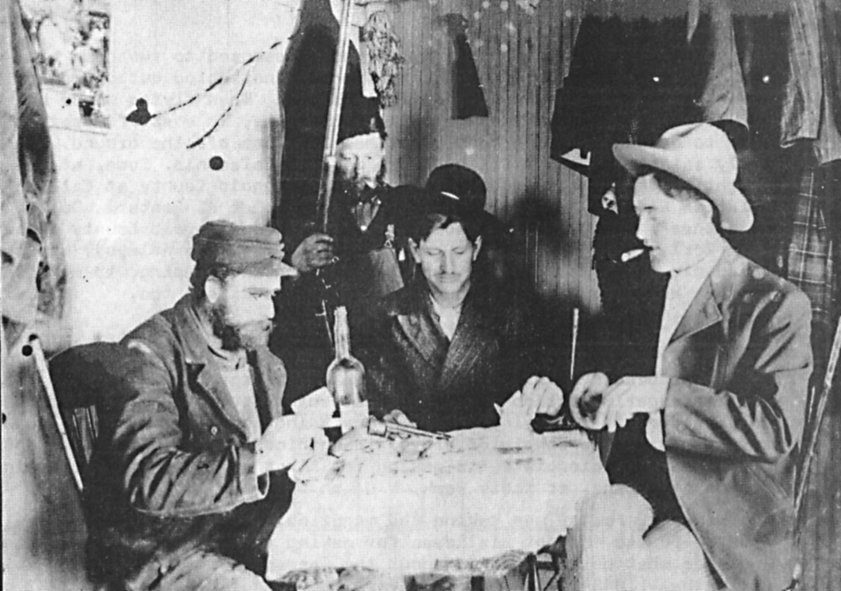
This week’s photo was scanned from a book by Ringgold County artist Holland Foster, who grew up in Caledonia. He included this photo in his 1978 book and identified the men as Clell Miller, Jesse James, Frank James, and Robert Ford. No, the names were not written on the back: he identified them by comparing the faces to other photos.
Foster goes on to say the room looks like a country lodge hall and it “could be” Caledonia. The James Gang, Foster believes, operated in and around Caledonia. And this week’s photo “may be” proof of that belief. As a researcher, I need more proof than a “belief.”
My best argument against is simple. If you were Wanted Dead or Alive, would you allow a photographer to set up his tripod and camera, then ask you to remain motionless for two seconds because the camera shutter speed is slow?
Another argument against is the camera technology of the day. James died in 1882 and I’ve only seen one Ringgold County photograph that I know for sure was taken before the year 1882. Ed Hatch, a Mount Ayr photographer, took a picture of the east side of the Mount Ayr square about 1873. The photo was of poor quality, but I would expect that. This week’ photo was taken indoors, but not in a photo studio.
So, that is how the myth was perpetuated. If anyone has documentation about Jesse James in Ringgold County, I dearly wish to peruse it. I have never seen it mentioned once in the thousands of old newspapers I have read.
I was informed the Caledonia Cemetery was inaccessible. I had never been there, so I decided to visit the cemetery myself. I did not succeed. I approached two gates, one facing north, one facing east. I believe the east gate was correct, but because I was in a car and not a four-wheel drive truck, I decided not to pursue the matter.
Caledonia was established in 1855 and got a post office the next year. The people and retail businesses came to town, but, by the 1890s, it was clear Caledonia would not get a railroad line. The post office closed in 1908. Gravel roads and the Great Depression reduced Caledonia to a hamlet by the end of World War II. Nothing is left of it today. Except for a cemetery that I’ve only heard about.