Snapshot of History
PROTECTED CONTENT
If you’re a current subscriber, log in below. If you would like to subscribe, please click the subscribe tab above.
Username and Password Help
Please enter your email and we will send you a password reset link.

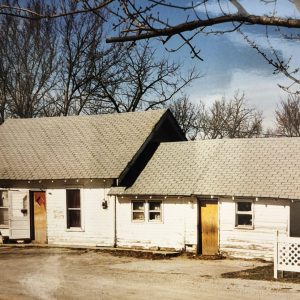
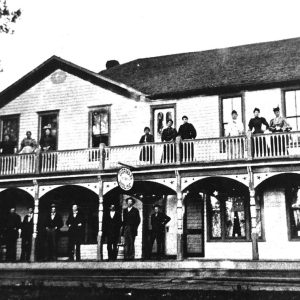
Evangelical Church at Ringgold City.
BY MIKE AVITT
I scanned this week’s picture from page 31 of Raymond Banner’s book, “ Ringgold City, Iowa 1844-2002: From First Settlement to Forgotten Community.”
The photo in the book is credited to Linda Swanson.
Ringgold City was located about nine miles south of Mount Ayr on county road P46, and two mile east on county road J67. Or, about three miles south-southwest of Caledonia in Lotts Creek Township.
The first known white settler in what would become Ringgold County was Charles Schooler in about 1844.
Mr. Schooler set up camp (near section 21, Lotts Creek Township) in an area with a disputed boundary. Iowa became a state in 1846, but the line between Missouri and Iowa was being contested.
The dispute was settled in 1850 and it turns out Schooler had settled in Iowa, not Missouri as he may have thought.
It appears Schooler was joined by his wife in 1845 and a man named Elam Barber in 1846. James and Mary Tetherow came to the budding community in 1847.
However, Charles Schooler’s first wife and infant child died about 1846 and it is presumed this was the beginning of Ringgold Cemetery. Charles was remarried to the niece of Elam Barber and the first white child born in Ringgold County was Manoah Barber Schooler in October 1847.
The community was called Schooler’s Grove in the beginning, but later came to be called Ringgold. This probably happened in 1855 when Ringgold County was officially organized. The new county boasted three towns in 1855: Mount Ayr, Caledonia, and Ringgold.
Some sources say the church was built in 1885, but I found two newspaper blurbs saying the church was under construction in July 1887 and the church being dedicated September 18, 1887. The dimensions were 32’ by 26’. Reverend Locke was the officiating minister.
The last store at Ringgold seems to have closed in the fall of 1935 with E. M. Mull as proprietor. The church probably closed about that time, too. The Watterson Road (P46) was graveled in 1935 and that changed everything.
The Ringgold City Evangelical Church was dismantled in 1939. The lumber was taken to Redding and a Pentecostal Church was built with the lumber from Ringgold City. Today, that building is the Redding Frontier Hall.