Snapshot of History
PROTECTED CONTENT
If you’re a current subscriber, log in below. If you would like to subscribe, please click the subscribe tab above.
Username and Password Help
Please enter your email and we will send you a password reset link.

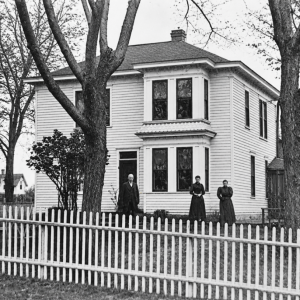
The former Odd Fellows building in Mount Ayr during the summer of 2005.
BY MIKE AVITT
After years of searching, I finally found the beginning of the Independent Order of Odd Fellows building in Mount Ayr.
It was constructed in 1877, two years before the railroad arrived, by John Currie and the Mt. Ayr Odd Fellows Lodge. John Currie was, I believe, the second owner of the Mount Ayr Hotel after Francis Ellis.
The Ringgold Record newspaper tells us Currie traded the hotel in the spring of 1877 to E. W. Critchfield so Currie could focus on the construction of the “brick block” at 102-104 E. Madison.
I have yet to learn who the bricklayers were, but I know the bricks were burned locally rather than brought in from afar. I also know some bricklayers completed a building for Kirby & Liggett in April 1877 and, therefore, would have been available to lay brick for Currie and the Odd Fellows.
I found this information because Tony Mercer succeeded in getting almost all of the Ringgold County newspapers on the internet. However, that alone didn’t do the trick. There is a “search feature” on the website that allows the researcher to narrow the search by date, word, or phrase.
I have struggled with this feature for months but I’m getting better. In the old papers, brick business buildings were called “brick blocks.” Barbers were called “tonsorial artists.” Photograph studios were called “art galleries.”
There are many subtle combinations and word usages that determine success or failure in a search. I’ve also learned how important it is to narrow down a time frame, which the feature allows the researcher to do.
Another discovery I made was the Ringgold County Board of Supervisors buying the “poor farm” (County Home) in October 1882. I don’t have any other details yet, but this beginning will lead to other information.
I’m learning more about William Timby’s brick buildings. A fire in November 1885 took out all of the buildings on the east half of the south side of the square. Mr. Timby hired George Smithson to lay the brick on his new building in 1886. We know this structure today as the Princess Theatre.
I’m only able to go back as far as 1872 on the digitized newspapers and I think some brick buildings were built prior to 1872. There was a brick building where Shafer Insurance is today.
In April 1890, a fire at 100 W. Madison jumped across the street to 100 E. Madison and damaged the building beyond repair so that early brick building was lost. I believe it was built before 1872.
Next week I’ll start a series about newspaper history.