Snapshots of History – Diagonal Schoolhouse
PROTECTED CONTENT
If you’re a current subscriber, log in below. If you would like to subscribe, please click the subscribe tab above.
Username and Password Help
Please enter your email and we will send you a password reset link.
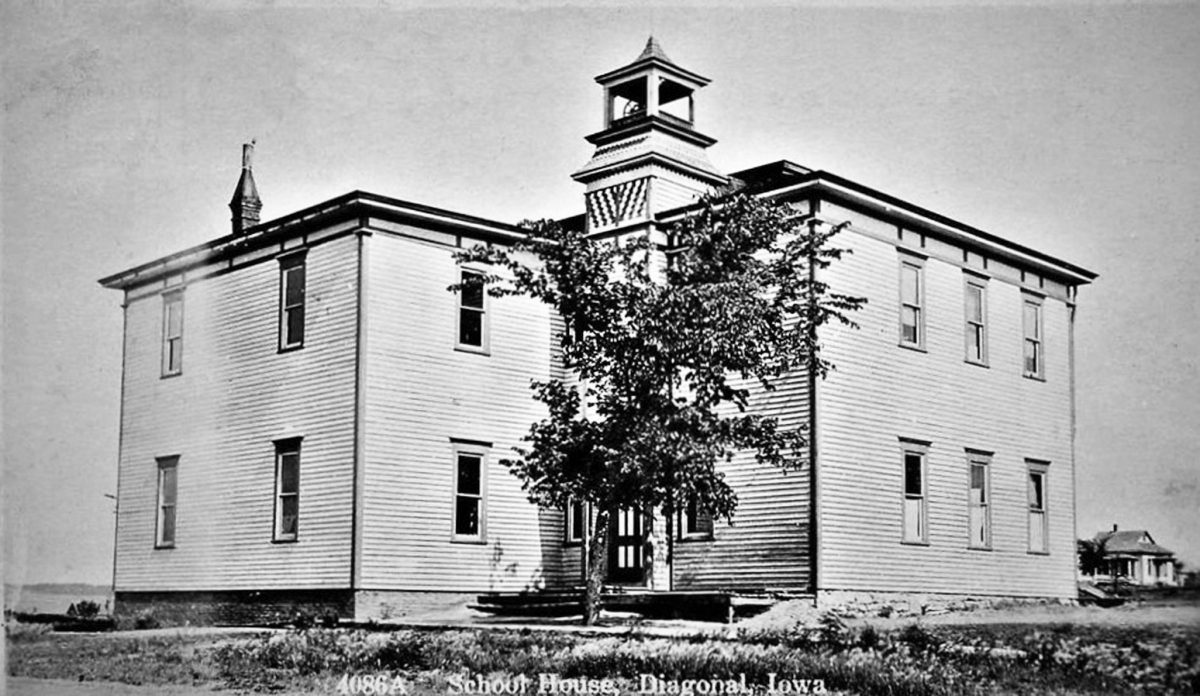
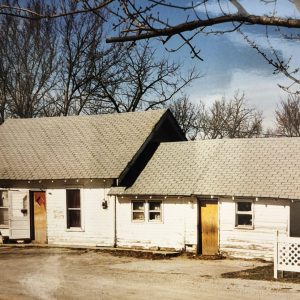
Diagonal’s first schoolhouse about 1912.
Diagonal’s first school building was believed to have been built in 1892. Previously, Washington Township No. 3 was used as Diagonal’s school.
This week we’ll look at the first year of Diagonal’s existence – 1889.
In late 1887, the Chicago, St. Paul, & Kansas City Railroad laid its tracks through Ringgold County creating the towns of Shannon City, Knowlton, Benton, Maloy, and Blockton. In doing so, the CStP&KC tunneled under the Humeston & Shenandoah Railroad creating the only railroad crossing in Ringgold County. This crossing was about one and a half miles east of Goshen and one mile south of Knowlton.
Goshen had been established as a town in 1882 on the Humeston & Shenandoah while Knowlton was established in late 1887 on the CStP&KC where the railroad built their coal chutes.
It is important to note the H&S was a branch line railroad, with usually poor service, and the CStP&KC was a mainline railroad which would prove to be an excellent line with superior service.
The CStP&KC also was a direct route to Des Moines and St. Joseph, Mo.
Many folks in Goshen thought the moving of Goshen and Knowlton to the crossing would result in a large and successful commercial center.
Knowlton said, “No thanks.” Knowlton had the coal chutes and were already situated on the main line. Why should they move?
Freight service began on the CStP&KC in January 1888; passenger service didn’t begin until August 1888. But it was clear the crossing would be very important.
Houses began to be moved from Goshen to Diagonal in April 1889.
In March 1889 it was thought the new town would be named Morton, but by April the name Diagonal was being used.
Goshen businesses announced their plans to move. But not everyone in Goshen was “on board” with the idea.
A writer in the April 18, 1889 Ringgold Record says the houses and businesses might move but the post office, school, church and grain facility were staying in Goshen. Besides, the businesses in Diagonal would be in direct competition with Knowlton one mile away. A legitimate point.
One week later another writer responds saying the advantage of the crossing will outweigh any disadvantages. The writer also points out the school was too “frail” to be moved, anyway.
By July 1889, a writer reports Diagonal had two stores, a hardware store, blacksmith shop, millinery, hotel, restaurant, and lumber yard.
The new town celebrated Independence Day and the H&S Railroad was now conducting business in Diagonal. Also, Rev. B. D. Himebaugh and his son-in-law, Dr. H. C. Reed, came to Diagonal in July so Dr. Reed could buy lots for his new home and drug store.
Both of these gentlemen would be instrumental in the early days of Diagonal and vicinity
By December 1889, the United Presbyterian Church was under construction, Dr. Reed’s drug store was nearly completed, E. H. Stringham was practicing law, and the H&S had placed a depot in the new town. The George Morrison Hotel was the second-largest in the county.
The name Diagonal comes from the nickname the railroad received around 1885 when the line was being built from Waterloo to Marshalltown to Des Moines.
Goshen was never incorporated and dissolved over the years. Knowlton forfeited its incorporated status in 1926.
The former Humeston & Shenandoah left in 1945 and the former CStP&KC pulled up stakes in 1984.
But Diagonal is still here! .