Snapshot of History: Clinton Motel
PROTECTED CONTENT
If you’re a current subscriber, log in below. If you would like to subscribe, please click the subscribe tab above.
Username and Password Help
Please enter your email and we will send you a password reset link.
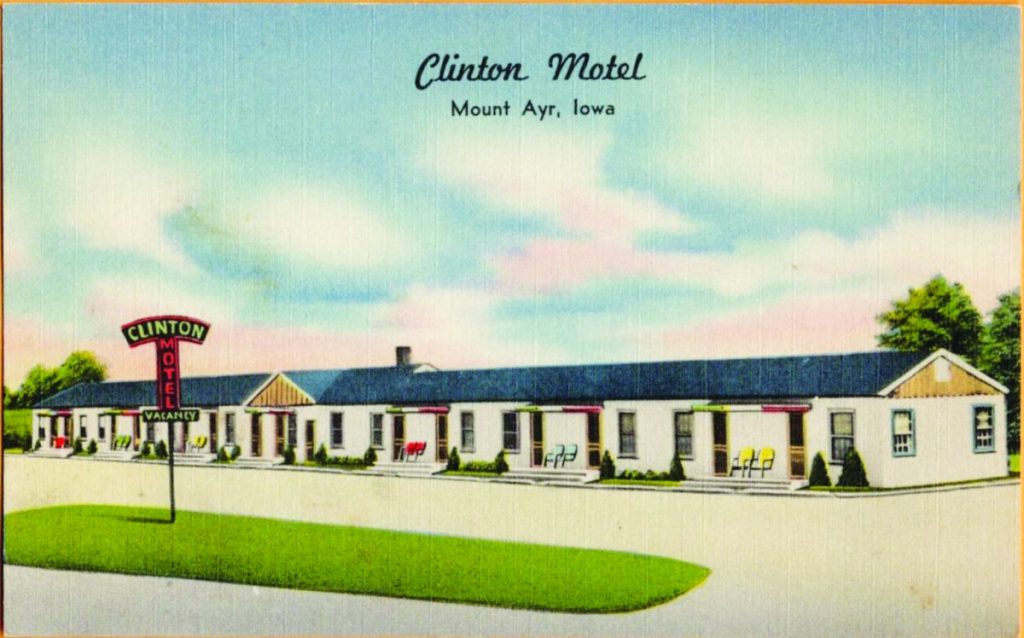
Clinton Motel postcard.
McDonnell Appliance donated an item to the Mount Ayr Depot Museum this week. It is one of those little metal racks that hold non-personalized checkbooks.
In the 1980s and before, local businesses offered counter checks to its customers with the names of local banks on the checks. No account numbers needed. The banks identified the check-writer by the signature.
But, the rack itself is only desirable to me because the front is printed with the words, “Security State Bank – Mount Ayr, Iowa.”
Let’s look at local advertising, especially print advertising.
The most common form of print advertising is newspaper ads, but there are many other forms.
This week’s picture is a scan of a “linen” postcard. Linen postcards were printed on paper with a cloth-like finish for color enhancement.
These postcards were popular from the 1930s to the 1950s and were colored with dyes and inks. Color photography was possible, but expensive. Photochrom postcards exploded in the 1950s and put the linens to bed.
The back of this week’s postcard advertises the motel’s amenities and a telephone number of 444.
Mount Ayr adopted the telephone dial system in 1966, so the advertising had to be updated.
About 1967, the Clinton Motel produced a Photochrom postcard with an updated phone number and updates on amenities like television.
The Clinton Motel opened in 1950 and was upgraded many times over the years; the advertising needed to reflect those upgrades.
The same is true of advertising matchbooks.
The Depot Museum is in possession of nine different Clinton Motel matchcovers; a reflection of the many changes in information about the motel.
For many years, the motel was approved by the American Automobile Association and the matchbooks of those years advertise that fact. Matchbook advertising was extremely popular from the 1930s to the 1970s.
Business cards are print advertising and are designed to be carried in a wallet or pocketbook. Matchbooks were discarded when the matches were used up, but business cards served no other purpose other than information.
We have a large collection of local business cards at the Depot Museum. The use of business cards is still common.
Another form of print advertising that was discarded after one year is the advertising calendar. This is another method of advertising that was popular in the past but less so now. One of the advantages of calendars is that the pictures can be changed every month or every year. We have many calendars on display at the depot museum.
Let me also mention, pre-WW II paper is much more difficult to find because of the paper-recycling that took place in that era.
There are enormous numbers of people like me who collect vintage print advertising. In my collection I have postcards, matchcovers, business cards, calendars, ticket stubs, coupons, brochures, menus, pamphlets, sports schedules, bank checks, ink blotters, printed napkins, maps, telephone books, etc.
But, before radio, there were two common ways to advertise: word-of-mouth and newspaper.
Newspaper advertising offers detailed information about a business or service that can be updated daily or weekly. I often use newspaper advertising in my research for “Snapshots of History.” And reading old ads is interesting. You see words like “undertaker” and “farrier” instead of “funeral director” and “horseshoer.” Bars were called saloons 140 years ago, then beer parlors 90 years ago, then taverns, 70 years. It was very rare for a drinking establishment to advertise in a newspaper until about forty years ago.
Okay, see you next week.