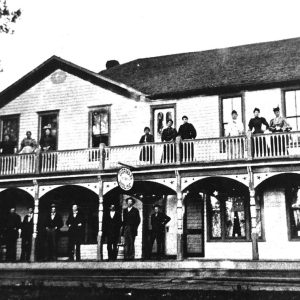
Snapshots of History: Simpson’ Department Store
PROTECTED CONTENT
If you’re a current subscriber, log in below. If you would like to subscribe, please click the subscribe tab above.
Username and Password Help
Please enter your email and we will send you a password reset link.
By Mike Avitt
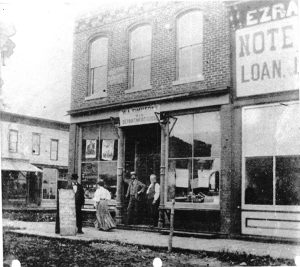
Simpson’ Department Store – Mount Ayr.
This photo was at the Mount Ayr Depot Museum when I joined in 2001.
The back of the photo had the date 1891, but no location. I was able to figure it out using the window configuration and Ezra McMaster’s law and loan office next door.
The sign above the department store door reads, “W. A. Simpson’s Big Department Store.” Simpson would later build a brick store at 112 S. Taylor and move there in 1899.
The building featured here is still standing at 101 W. Monroe as the Princess Theatre.
William Timby had the brick storefront erected in 1886 and it was first used as a dry goods store. Rooms above stores were often used by doctors, dress makers, insurance agents, lawyers, and photographers.
This building became the Princess Theatre in 1914, but let’s go back to the beginning.
In late June 1909, George Adams opened a moving picture show in the building west of Kinsell Hardware. This would be about 202 W. Madison. In December 1910, Adams sold the Elite Theatre to J. J. Michael.
Mr. Michael changed the name to Crystal Theatre and moved the business to 120 N. Taylor Street in May 1911. The building at 120 N. Taylor was formerly a furniture store, so it had some size to it.
He sold the Crystal Theatre to Claude McDonald in November 1912.
Claude changed the name to Star Theatre and sold the firm to Fred Mack in March of 1913. Mack sold the Star Theatre to Littell P. Todd in January 1914. Mr. Todd was referred to as “Tell” and was the paternal grandson of Henry Todd, a businessman of Goshen, Diagonal, and Mount Ayr, Tell’s maternal grandfather was Major Robert G. Rider who became a doctor after the Civil War and practiced at Beaconsfield. Tell’s aunt Etta Rider was Superintendent of Ringgold County Schools beginning about 1908.
In July 1914, Tell leased the building at 101 W. Monroe from William Timby’s widow, Martha.
Mr. Todd hired Clyde Rusk, a highly respected carpenter, to build an addition to the building which would convert the former department store into a theater.
All went according to plan and the Princess Theatre debuted on September 9, 1914 with the movie, “Lucille Love – Part 4.” The first three parts were shown at the Star Theatre.
Meanwhile, the Star Theatre had been sold to T. L. Kier and he was showing movies, too. Kier changed the name to Bon-Ton Theatre. The Bon-Ton changed hands a couple of times and the name was changed back to Star.
In October 1915, L. P. Todd and his partner, F. E. Miars, purchased the Star Theatre. In March 1916, Miars bought out his partner Tell Todd and announced plans to build another 30-foot addition to the south end of the Princess Theatre and update the equipment.
This addition would house a stage, twelve feet deep, and as wide as the building for vaudeville acts. It also provided for additional seating.
Miars traded the Princess Theatre to Homer Foster in 1918.
So, now we know when the additions were built and we are watching movies there 110 years after Tell Todd created the Princess Theatre.