Looking Back: Mount Ayr Square
PROTECTED CONTENT
If you’re a current subscriber, log in below. If you would like to subscribe, please click the subscribe tab above.
Username and Password Help
Please enter your email and we will send you a password reset link.

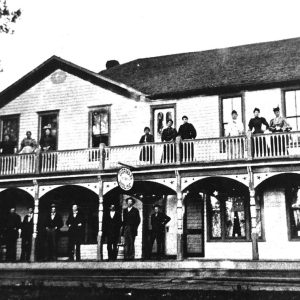
South side of the Mount Ayr square about 1899.
By Mike Avitt
This week’s picture appears to have been taken from an upstairs window on the west side of the Mount Ayr square.
Professional photographer M. G. Maxwell was located upstairs at 107 S. Fillmore from 1899 until 1902.
We will continue with our December 1893 tour of the square courtesy of J. S. Shepherd, editor of the Mount Ayr Journal.
In 1893, about where the old Skelly Station is on the south side of the square, there were two wood-frame buildings. They both can be seen in this week’s photo.
The one on the right was lost in the bank fire of November 14, 1900. It was John Lester’s shoe repair shop in 1900. In 1893, Editor Shepherd bypasses this building so it may have been vacant.
The building on the left, next to the alley, was the blacksmith shop of John Gray.
Thomas Liggett occupied what we call the Dean Jacobs Fur building in 1893 with his grocery store. Mr. Liggett’s building was two stories when he had it built in 1891. Dean Jacobs made it a three story building in 1933.
You can see the bricks that were added in 1933 when looking at the top of the side walls even today.
As I write this article, I’m being assisted by the notes I’ve been collecting for twenty years, and by the plat maps which are available through the Library of Congress website. I’m currently looking at Mount Ayr city plats from 1886 and 1893. These are extremely helpful when researching Mount Ayr history.
There is an empty lot east of Liggett’s and then we find the store of W. S. Berkey, a long-time Mount Ayr retailer. Mr. Berkey sold paper products, notions, gifts, toiletries, holiday decorations, etc.
This building and the next two east, were built soon after a fire in November 1885 took out all the buildings from the corner to the alley.
Next door east is the office of attorney Ezra McMaster. Mr. McMaster dealt in farm loans, insurance, and real estate. His office even served as a bank briefly while the former Citizens Bank was being purchased and organized as the Iowa State Bank.
It was Ezra McMaster’s former house at 205 W. Monroe, that was converted into a funeral parlor and serves as Armstrong Funeral Home today.
In the building that is now the Princess Theatre, W. A. Simpson had his grocery store in 1893. Mr. Simpson would build a two-story brick at 112 S. Taylor and move there in 1899. Mr Shepherd doesn’t mention what was located upstairs.
On the corner where the city hall is now was the furniture store of Adam Warner. He was also a very active carpenter and built coffins, furniture, and houses. Warner had only been at this location a couple of weeks in December 1893. The grocery firm of Saltzman & Sellards had just left this address and moved into the recently completed brick building at 106 W. Madison.
The next building south was the Mount Ayr Produce Company managed by George Roby. Mr. Roby was a former Mount Ayr newspaper publisher. Bring your eggs, cream, and poultry to Mr. Roby.
The tour by Mr. Shepherd was supposed to be continued in next week’s Mt. Ayr Journal, but those pages are missing from the next issue, so I will give you an account of the 1893 east side of the square next week from my notes and maps.
I’ll tell you an interesting story about the building where Lucky Lanes is now.