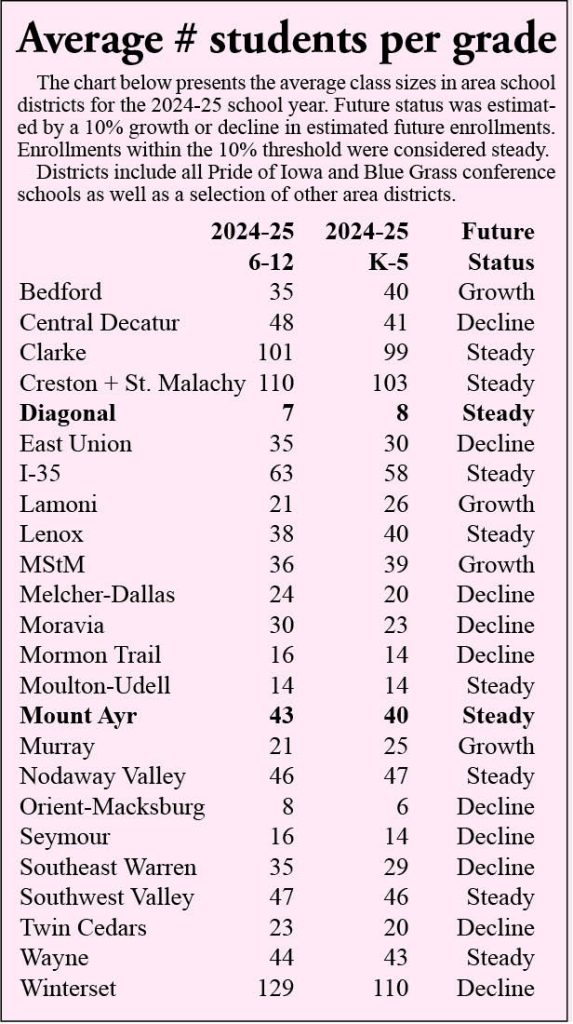
Can students per grade predict future enrollment?
PROTECTED CONTENT
If you’re a current subscriber, log in below. If you would like to subscribe, please click the subscribe tab above.
Username and Password Help
Please enter your email and we will send you a password reset link.
[Editor’s Note: This week we present the third of a four-part series examining student enrollments in area school districts. Last week’s article presented the effects of open enrollment on district populations. This week presents average grade size as a potential indicator of future district enrollments.]
As has been documented in this series of articles dealing with school district enrollments, student numbers continue to decline in most districts in the area.
Because enrollments are so crucial to the financial viability of Iowa school districts, educational leaders in our communities continually monitor those factors affecting enrollment numbers.
General population decline in most rural counties is one factor that cannot be controlled at the district level, and while school leaders do not have a crystal ball to predict if or how fast a decline in enrollment may jeopardize the future of their schools, they can survey the pipeline of students coming up through the grades to get a rough idea of what’s to come.
Administrators often compare the size of one year’s graduating class to that year’s kindergarten class as one predictor.
However, one uncommonly large or small class at either of those two levels can skew that prediction.
To lessen the impact of one large or small class, perhaps a more reliable prediction can be made by comparing the average number of students in grades K-5 and in grades 6-12.
For example, in the 2024-25 school year, the average grade size at Mount Ayr Middle/High School is 43, while 40 is the average grade size at the elementary school. While that comparison reveals an estimated 7.5% decline in enrollment in the coming years, the student population overall remains relatively steady.
The Shenandoah Community School District is not as fortunate. In the current school year, the average number per grade in grades 6-12 there is 101. Contrast that number with the average number of students per grade in grades K-5 — 72 — a decrease of 29%. In fact, the Class of 2025 at Shenandoah numbers 127 students. This year’s junior class has 131 students. Meanwhile, only 55 students are enrolled in this year’s first grade at Shenandoah.
At the other end of the spectrum, suburban school districts surrounding Iowa’s largest cities continue to show growth in enrollments.
For example, in the Van Meter school district west of Des Moines, grade size in grades 6-12 averages 81 students. Grade sizes in K-5 average 89 students — an increase of 10 percent. Van Meter is already constructing additional classroom and other facility space to accommodate the expected increase.
Obviously, statistics from one year cannot predict realities five or ten years in the future. Variables such as new employers moving in or industries moving out can impact school district populations and subsequent enrollments, both positively and negatively.
However, one variable remains a wild card in any discussion of future public school enrollments – Education Savings Accounts, otherwise known as private school vouchers. Those will be the topic of the discussion next week.