Snapshots of History by Mike Avitt
PROTECTED CONTENT
If you’re a current subscriber, log in below. If you would like to subscribe, please click the subscribe tab above.
Username and Password Help
Please enter your email and we will send you a password reset link.
I received a book from Lora Stull of the Mount Ayr Record News I had never seen before. It was a compilation of biographies first published in the Ringgold Record newspapers of 1880-81. I knew of the biographies scattered through the Ringgold Record newspapers, but was unaware of the book put together by Lena Saville and Mildred Shay and published through the Ringgold County Historical Society.
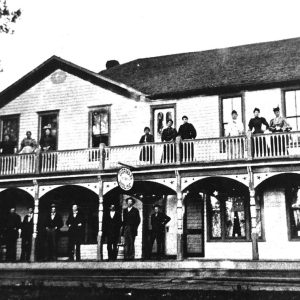
Ringgold Record publisher George Stephens knew the historical importance of weekly newspapers and often included material specifically for historical reasons. Mr. Stephens is responsible for the building (1881) shown with this week’s article and it still stands at 119 N. Taylor St. Let’s look at a few of the biographies.
Wendell Poor was born near Redding, Mass. in 1799 and moved to Iowa in 1854. He located in Ringgold County in March 1855. On August 30, 1855, he became postmaster of the Redding (named after his hometown in Massachusetts) Post Office located north of present-day Redding. Now we know how Redding got its name.
See how historically important these snippets can be? Mr. Poor also served as the second Ringgold County Superintendent of Schools after the first one, Charles Schooler, resigned. Mr. Schooler was the first white settler in what would become Ringgold County.
Mike Rush got his start as a merchant in the store that housed the Redding Post Office. In 1877 he established what would become Maloy under the name Delphi. He was successful in getting a post office there before selling out to J. M. Fox. Rush then started the town of Delphos in 1880, opening a post office there. He also operated a grocery store at Delphos.
Michael Stahl came to an area west of present day Diagonal in 1856 and served in more capacities than this page can hold. He supervised the construction of the first church building erected in Ringgold County in 1858. He was the first postmaster at Goshen in 1875 (the post office preceded the town of Goshen by 7 years). He built the first frame structure in Mount Ayr in 1861 as he was a master carpenter. Stahl traveled great distances to obtain provisions for his community before the railroads got close. He is a Ringgold County legend.
Barbara Saltzman’s name is spelled “Saulzman” in the article, but her maiden name was Mosier so we know Saltzman is correct. Her husband Joseph died in 1872 and Barbara continued to operate the farm which included a brick house two and a half stories high. It was estimated there were more than 100,000 bricks in the house. I’d love to see a photo of that.
Reverend William Brown came to Mount Ayr in 1868 and served as pastor of the United Presbyterian Church for many years. In the mid-1870s, Brown moved to Eugene as a stock-raiser and merchant, but also served as pastor of the Eugene U. P. Church off and on for 10 years. After Tingley was established in 1882, Rev. Brown preached to the U. P. congregation there.
Dr. A. White was practicing in Mormontown (Blockton) when his biography was recorded. He previously worked in Ringgold County and his practice still took him to a large area in northern Missouri and southern Iowa. He was born in Baden, Germany in 1846.
Most of the biographies concern the difficulties of pioneer life and the pioneer spirit that overcame those difficulties. These were hardy souls.
A book came out in 1887 that records the biographies of some of these same people. By 1887 some Ringgold County towns had been established and there is info related to the formation of those towns. Next week we will revisit the ghost town of Eugene as I have found more information on that once bustling burg.