Snapshots of History: Redding High School
PROTECTED CONTENT
If you’re a current subscriber, log in below. If you would like to subscribe, please click the subscribe tab above.
Username and Password Help
Please enter your email and we will send you a password reset link.
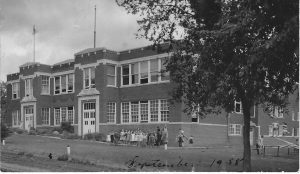
Redding High School in 1938.
By Mike Avitt
I found a little more information on the beginning of Redding’s brick schoolhouse.
The Redding newspapers from this time frame are not available and the Redding correspondent to the Mount Ayr newspapers was inconsistent or non-existent. The Redding Centennial Book says the school was built in 1914 and added onto in 1917. And that’s close.
In the summer of 1915, bonds were sold and a site was selected. Work on the new building was commenced in September 1915.
It appears G. R. Turpen was doing plaster work there in December 1915. Students first occupied the school in late January 1916. It was announced the building was completed at a cost of $10,000 in February 1916.
Please note the short amount of time the building was constructed in and the low dollar amount. This tells me the original part of the building was quite small, that is, no gymnasium.
In September 1916, the Mount Ayr Record-News and the Tingley Vindicator are calling the new school “consolidated.” The Vindicator said that recent laws mandating courses in domestic science, vocational agriculture, et al. would benefit consolidated (as opposed to “independent”) schools in the future. The Vindicator gave the enrollment at Redding as 190 and Mount Ayr gave it as 180. This refers to all students.
I found nothing helpful in 1917 but I discovered an article in February 13, 1918, relating Louise Askren, county superintendent of schools, attended the dedication activities at the Redding High School.
The Record-News stated the completed school was constructed at a cost of $35,000 and was modern in every way. The new school employs eight teachers. So, it appears most of the building was erected in 1917.
The last year for high school classes at Redding was 1958 and there were eight graduates: Ila Lantz, Paula Saville, Arlene Hall, Nona Lambert, Freda Shaw, Carl Edman Combs, and Marvin Mercer.
The building was used for grade school classes for years afterward. And the schoolhouse still stands today, although it is quite dilapidated.
Okay, I have some space for Clinton Township rural schools.
The Redding Herald of September 8, 1938 says Fairview School, in section 22 of Clinton Township, would be vacant for the first time in 40 years.
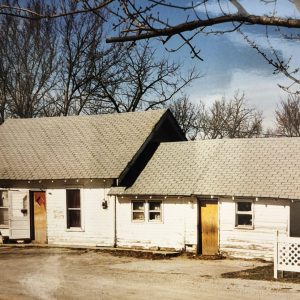
There is a brief history of the school but the historic greatness of this school is that it is still standing (last I knew). It is one of only two Ringgold County rural schools on its original foundation.
Brush College, Clinton Township No. 4, was only a couple of miles from Blockton and I read where some families were pulling their kids from rural schools and sending them to Blockton.
By 1943, Blockton probably had the advantage of school buses and gravel roads. It was therefore possible (and desirable) to send children to Blockton. In 1943, Kathleen Faubion was the teacher at Brush College and she had charge of six pupils. I believe this was the last school year for Brush.
Miller School, in section 9, closed in 1936 as some students had moved out of the area. In 1942, Miller reopened with Jean Kettle as the teacher. Then I found an interesting notice in the August 15, 1957 Record-News.
The voters of Clinton Township were asked to decide the fate of Fairview School and the property it sat on. Same for Brush College. Miller School was not mentioned, but guess where the voting place was? Miller School! That was probably the regular voting location for Clinton Township voters.
Miller school reunions were still being held in the 1960s.
Clinton Township didn’t have many rural schools and part of the reason is Blockton and Redding would have eliminated a rural district within a mile and a half radius of each town. Some townships in Ringgold County had as many as nine rurals schools.