COUNTY BUCKS TREND
PROTECTED CONTENT
If you’re a current subscriber, log in below. If you would like to subscribe, please click the subscribe tab above.
Username and Password Help
Please enter your email and we will send you a password reset link.
 Statewide farmland values decline, but Ringgold County shows 4.4% increase
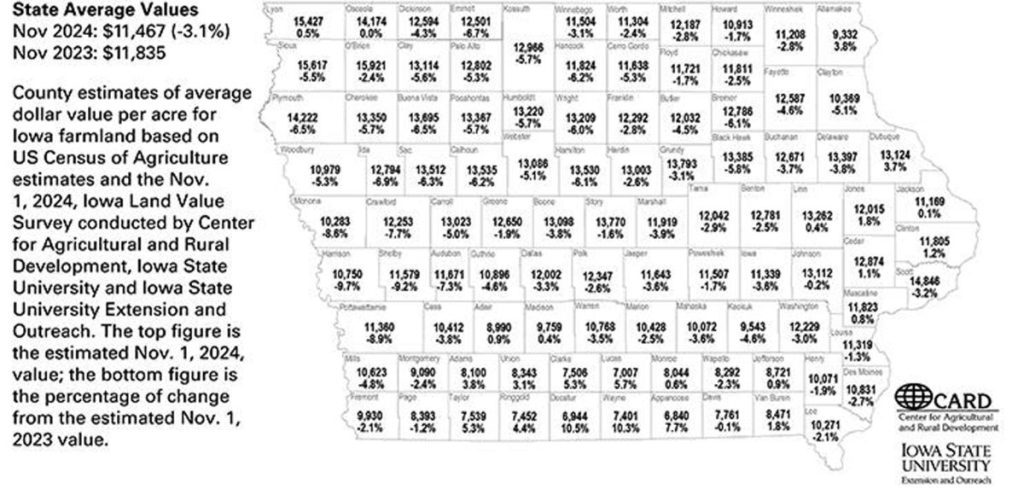
The annual Iowa State University Land Value Survey found that farmland values decreased 3.1%, or $369, to $11,467 per acre.
However, Ringgold County and most of southcentral Iowa bucked this trend.
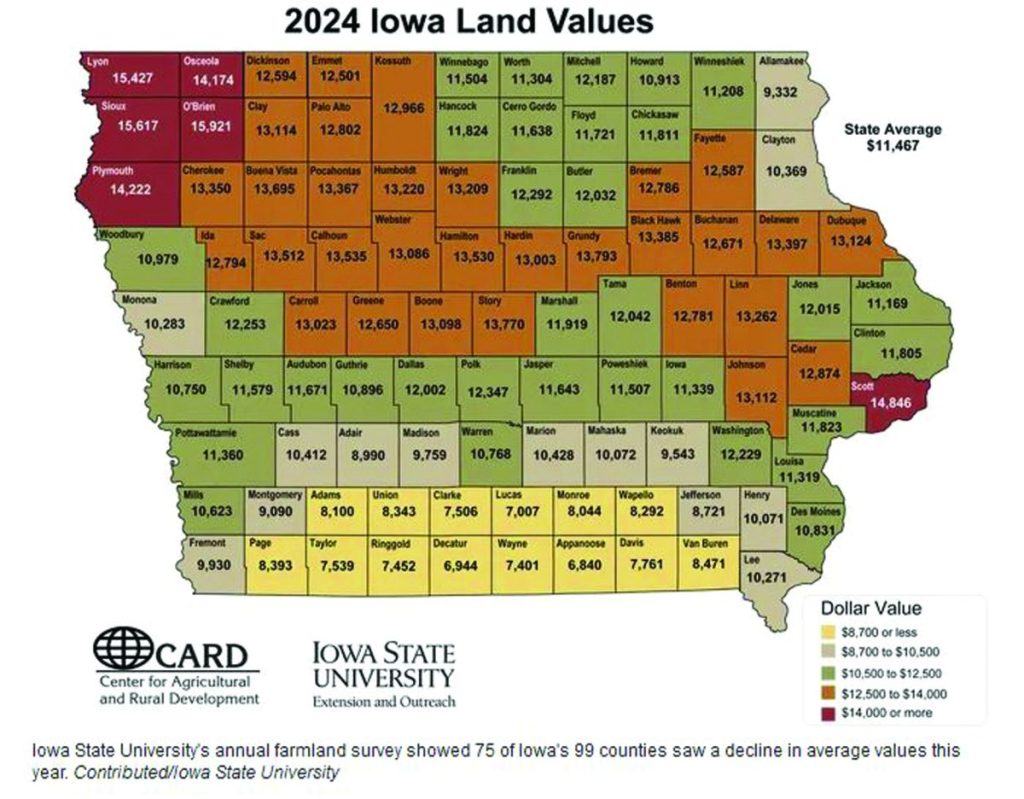
According to the survey, farmland values in Ringgold County increased by 4.4% in 2024 to $7,452 per acre.
The state decrease this year nearly erases the 3.7% increase from last year and ends a five-year trend of increasing prices.
The nominal value of an acre of farmland this year fell from last year’s record high, but is still higher than the nominal value in 2022.
When adjusting for inflation, the 2024 average value is 2.5% lower than 2013’s inflation-adjusted values.
“We saw land values rise for five straight years, including surges of 29% and 17%, which naturally leads to a reset or balancing in the market,” said Dr. Rabail Chandio, who is responsible for the annual survey. “If we look back to the previous peak in 2013, the market “adjusted” with relatively small declines spread over a few years.”
Chandio said that survey respondents noted falling commodity prices, persistently high interest rates, and elevated input costs as factors that have tightened profit margins and placed increasing downward pressure on land values across the state.
While the Federal Reserve started cutting rates in late 2024, Chandio said the impact of the past two years of high interest rates is still weighing on farmland values. “It takes time—sometimes up to a decade—for interest rate changes to fully ripple through the land market; and, although rates recently dropped, with another cut on the horizon, it’s not enough yet to ease the pressure from those earlier hikes as we move into 2025. If rates fall within a couple of years, we could see farmland values beginning to recover sooner. But if rate cuts take longer, we may see declines persist for another year or two,” she said.
The lower commodity prices will also affect more than just land values—farm income is expected to fall 4.1% this year, following last year’s 17.4% drop, as lower commodity prices weigh on crop cash receipts. “While crop receipts are down, livestock receipts are up 8.4%, offering some balance. So, livestock markets, like cattle and hogs, have fared relatively better, but high input costs are still exerting enough pressure to keep margins very tight,” Chandio said.
Iowa’s South Central crop reporting district was the only district to see an increase in land values. Chandio said that when land values in other parts of the state surged during the COVID-19 pandemic, the southern districts lagged behind. “While the South Central district saw an increase this year, the other two southern districts reported only minimal decreases, indicating a relatively stable trend overall,” Chandio said.
Looking forward, survey respondents had a clear distinction between their short-term and long-term expectations for land values. Over the next year, 58% expect declines, with most predicting drops of less than 5%. However, looking further ahead, respondents are much more optimistic—80% believe land values will increase over the next five years, with 36% forecasting gains of 10%–20%.
“This long-term confidence aligns with expectations of more stable or slightly rising corn and soybean prices, suggesting that while the short-term outlook may be challenging, the market’s foundation remains strong,” Chandio said.
Land Values by County
Seventy-five of Iowa’s 99 counties showed a decrease in land values. O’Brien County topped the list this year with a per-acre value of $15,921, though values there decreased 2.4%, or $392, per acre since last year.
Appanoose County reported the lowest value, $6,840 per acre; however, those values are an increase of $486, or 7.7% per acre.
Shelby County saw the largest dollar decrease with a loss of $1,170 per acre. Harrison County saw a decrease of 9.7% per acre, the largest percentage loss by county. Wayne County saw the largest dollar increase, $690, in average values; however, Decatur County saw the largest percent increase in values at 10.5%. Osceola County reported the lowest percentage and dollar increase at less than 0.1% and $3 per acre, respectively.
Land Values by Quality
Statewide, low-quality land now averages $7,450 per acre, a decrease of 2.8% or $215 per acre. Medium-quality land now averages $10,740 per acre, a decrease of 3.0% or $335 per acre. High-quality land now averages $13,930 per acre, a decrease of 2.6% or $367 per acre.
The Northwest district again reported the highest values for low-, medium-, and high-quality land at $9,162, $12,975, and $16,171 per acre, respectively. Despite being only district to see an overall increase (3.63%), the South Central district reported the lowest values for low-, medium-, and high-quality land at $5,071, $7,864, and $10,659 per acre, respectively.
In terms of both percentage and dollar amounts, the West Central district saw the largest declines in low-, medium-, and high-quality land, and average land values, with values falling 7.4% or $943 per acre on average.
Low-quality land in the West Central district saw the largest percent decrease (11.5%) and the largest dollar decrease ($1,043 per acre). Low-quality land in the Central district saw the largest percent (5.1%) and dollar increase ($404) in per-acre value.
Medium-quality land saw the largest percent decrease (7.7%) and dollar decrease ($928 per acre) in the West Central district. The South Central district saw the only increase in medium-quality land values in terms of percentage (up 4.9%) and dollar change (up $366 per acre).
High-quality land saw the largest percentage decrease (7.1%) and dollar decrease ($1,059 per acre) in the West Central district. The South Central district reported the only increase in high-quality land in terms of percentage (9.7%) and dollar value ($940 per acre).