Provision Feed Mill now operational
PROTECTED CONTENT
If you’re a current subscriber, log in below. If you would like to subscribe, please click the subscribe tab above.
Username and Password Help
Please enter your email and we will send you a password reset link.
Over 10,000 bushels of corn turned into feed each week
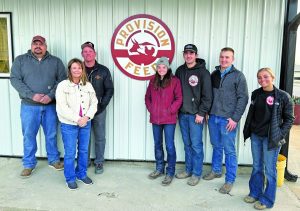
The Provision Feed Mill team includes (l to r by their sign) Jordan Eggman, Darla and Doug Sobotka, Katie and Marcus Daughton, Rhett Larson, Erin Sobotka and Cody Shay (not pictured).
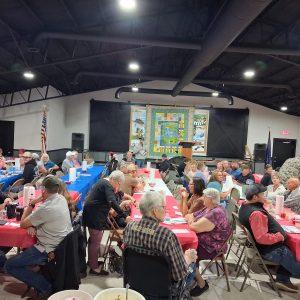
The prior Schalpia Feed operation and Farmer’s Coop site has completed transformation into Provision Feed Mill and is now operational. Over fifty people packed into the facility for an open house and site tours of the newly remodeled site at 317 Broadway Street on Saturday, January 18. Visitors were greeted at the front desk which incorporated the original manual scale and a metal sign illuminated by red lights.
The eager crowd was split into two initial groups for opposite walking tours of the facility. Katie Daughton led the first group through an interior tour of operations, while her father, Doug Sobotka led a second tour outside, eventually meeting up with the other tour group.
Daughton’s tour began with a look at one of the five scales, with totes above, that measure a mix of ingredients. Currently, they are only using three of the five scales. On the day of the tour, tryptophan and salt were being mixed into the feed. Tryptophan is typically used to improve animal growth performance. When the equipment is turned on, it mixes the tryptophan into the feed using an auger. Next, the salt dumps in and a gate in the bottom opens up to send the feed over to the mixer on a conveyor.
The tour continued to the microsystem that houses 16 different smaller inclusion ingredients with individual scales to measure out the amount of drugs that need to go into the rations.
“We have individual scales for all of the drugs just as a secondary measurement,” explained Katie Daughton.
“A lot of these, like some of the inclusion rates are like 0.9 pounds per ton. They’re very, very small,” stated Daughton, “so it needs to be pretty accurate.”
All ingredients are then combined in the 3 ton mixer with a double ribbon, which efficiently completes mixing in 180 seconds. An additional 60 second mix cycle occurs after liquids are applied.
The tour moved through the facility into an area where three main scales weighed minerals like limestone, corn and soybean meal, and DDGS.
Three sets of truck scales at the feed mill allow for bulk ingredient receiving which include DDGS, limestone and soybean meal.
Three sets of rollers grind the corn and can be set at different levels for various grind sizes.
The tour continued around the outside of the building to the load out bin area. Currently, they have two trucks, four 15 ton bins and two 24 ton bins. Eight more 30 ton bins are planned to be added for additional load out storage.
Daughton also showed visitors one of the truck scales where farmers drive in to the mill to be filled and weighed.
Truck traffic into the feed mill goes from west to east, so the full trucks come in from the main street, and exit on the east side of the mill to connect to the highway. The mill is equipped with plenty of extra ingredient storage and two forklifts, one is dedicated to indoor use for biosecurity reasons.
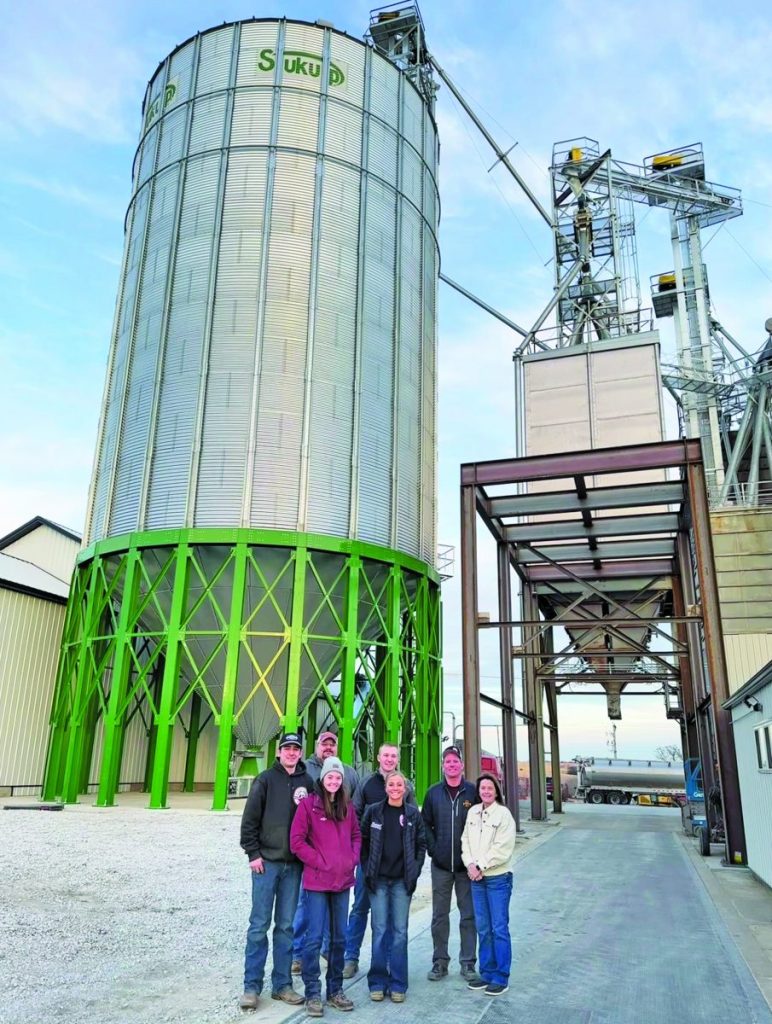
Members of the Provision Feed Mill stand next to the 120 foot tall grain bin (front row l to r) Co-owners Marcus and Katie Daughton, Erin Sobotka, and their support team Doug and Darla Sobotka. Operations Manager Jordan Eggman, and employee Rhett Larson stand in back.
The large 55,000 bushel hopper bottom bin and leg stands at least 120 feet above the feed mill, and commands attention from those passing by.
Inside the new covered drive in bay, farmers can drive straight in to dump their corn into the pit. The pit is 14 feet deep, and can fit about 1,800 bushels in it. That allows farmers to drive in and pull on to the scale to be weighed, and then they dump and their weight is noted again, with the whole process taking five minutes or less. Their goal is to one day be set up so farmers won’t need to go into the office.
“We have a probe right now, but since we had to put up our extra load out bins, it’s not operational yet,” said Daughton.
In the next few weeks they will be working to get everything set up to have the probe ready to use.
“We’ll have RFID tags, so they can just pull in,” Daughton said. “A kiosk with a printer will be equipped to print their ticket, and then they’re good to go.
Presently, they are only using about 10,000 bushels of corn a week, but that number is expected to grow as they expand their operation.
“From beginning to finish, it takes about a ton of feed to feed three hogs,” stated Sobotka. “For every semi load of feed that goes out of here, its 72 hogs that we’ve fed.”
While Provision Feed Mill plans to produce feed in response to customer needs, they want to ensure they can do it in a cost effective manner. Presently they are producing primarily pig feed.
“If we make feed and it’s not convenient, it’s going to be expensive, and then that’s not good for the customer,” said Sobotka. “We’re going to do what we think is best for the customer and us. If we can make cattle feed and make it right, I think we should. And if we can’t, we should tell the customer, no, we can’t do this,” stated Sobotka. “That’s my take on the situation.”
Sobotka was quick to mention he is zero percent owner in Provision Feed Mill, and doesn’t make those decisions.
“I just work here,” Doug said. His main role has been setting up the computer operation of the system, and he plans to pass the operation of the system on to the rest of the team.
“Without computers, this place is dead,” stated Sobotka.
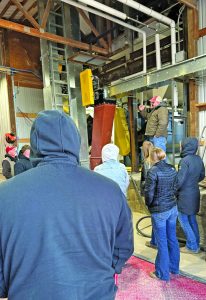
Jordan Eggman, who is the leading feed mill operation, talks about the re-use of existing feed bins that were flipped around during a site tour of the new Provision Feed Mill last Saturday. Sisters Katie and Erin Sobotka own the new business.
He noted they do have several backup options to keep the computer system operational. Sobotka then introduced Jordan Eggman, the operations manager of ProVision Feed.
“He’s the guy that is always smiling,” said Sobotka.
Eggman explained how the scales empty into the mixer, and the bins automatically start filling the bins, which is a continual process.
Daughton noted they plan to build another warehouse at some point, and potentially include a wash bay or something similar. All of their trucks have to be washed at least once a week. After they go to a sow finisher’s site, then the trucks need to be washed before they can go deliver to a sale site.
More information about Provision Feed can be obtained by calling 641-321-0504 or visiting their website: www.provisionfeed.com.