Open enrollment a challenge for area school districts
PROTECTED CONTENT
If you’re a current subscriber, log in below. If you would like to subscribe, please click the subscribe tab above.
Username and Password Help
Please enter your email and we will send you a password reset link.
[Editor’s Note:This week we present the second of a three-part series examining student enrollments in area school districts. Last week’s article compared the latest certified enrollment numbers to those from five years ago. This week examines the effects of open enrollment on district populations.]
Back in the 1989-1990 school year, Iowa was the second state in the nation to adopt an open enrollment policy for students. Today, with certain restrictions, students are allowed to attend a different school district from the one in which they reside. This includes online and private schools.
Districts strive to retain their resident students due to the financial impact of state supplemental aid to schools. In the current 2024-2025 school year, state aid amounts to $7,826 per pupil, so a loss of even a handful of students can quickly translate to the equivalent of one teacher salary.
Students who open enroll out of a resident district are still counted in the resident district’s certified enrollment, and those districts receive state aid for those students. However, resident districts must later pass along those aid dollars to the receiving districts.
Another wrinkle in the open enrollment discussion has come with the advent of entirely online schools. The most extreme examples of online open enrollments come at both the CAM district in Anita and Clayton Ridge district in Guttenberg. Both oversee online schools – Iowa Connections Academy at CAM and K12 Iowa Virtual Academy at Clayton Ridge.
CAM has a resident student count of 357.7. At total of 59.2 students open enroll out of the district, but a whopping 1,570 open enroll in, thanks mostly to the online school.
According to the original 2012 contract between the CAM district and Connections Academy, CAM must pass along 97% of state aid for each Connections student with CAM retaining the remaining 3% or $50,000, whichever is greater. In other words, if roughly 1,500 of CAM’s open enrollment comes from Connection Academy, the CAM district could still retain over $350,000 in state aid due to open enrollment.
Clayton Ridge has a resident student population of 565 with 72 choosing to open enroll out of the district. Conversely, 1,464 open enroll into Clayton Ridge, most through the K12 route, with a similar state aid sharing agreement in effect.
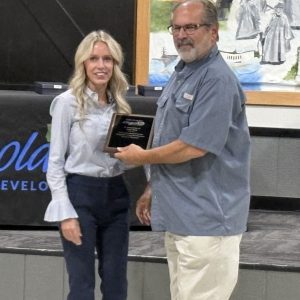
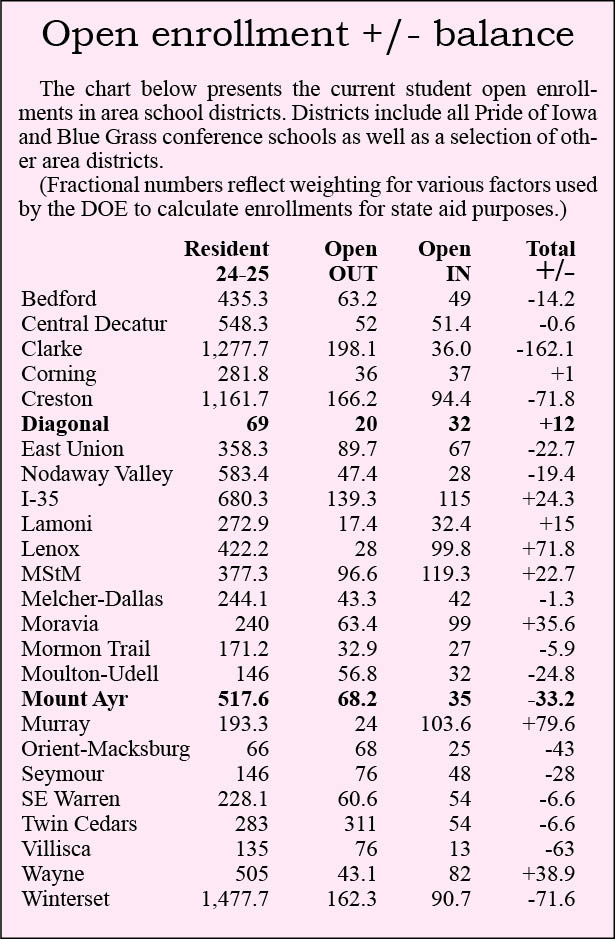 Mount Ayr recently announced the creation of its EVOLVE online high school in an effort to offer resident students an alternative to open enrolling out of the Mount Ayr district to find a non-traditional high school experience.
Beyond the online school populations, the number of students open enrolling out into private/parochial schools has not greatly affected area districts. The only exception comes in Creston, the site of the only state-certified private elementary school in the area. According to statistics from the Iowa Department of Education, St. Malachy Catholic Elementary recorded a student population of 147 in grades K-8, the majority of which are resident students in the Creston district.
[Next week’s article will compare how class sizes at the elementary level could predict overall district enrollments in the coming years.]