Airport funding concerns addressed
PROTECTED CONTENT
If you’re a current subscriber, log in below. If you would like to subscribe, please click the subscribe tab above.
Username and Password Help
Please enter your email and we will send you a password reset link.
An entity of its own; airport commission votes to continue use
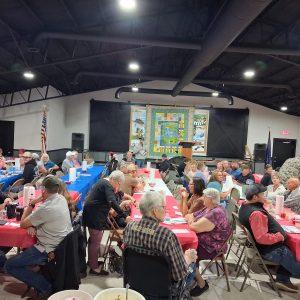
At a special joint meeting of the Mount Ayr City Council and the Airport Commission held on Monday, March 24, roles were clarified for each group, expenditures were reviewed, and both entities agreed to move forward with pouring concrete footings for new hangar doors.
City Administrator Brent Wise opened the meeting by clarifying that while the City of Mount Ayr owns the airport and sets the budget, the Airport Commission is an entity of their own, and can make their own decisions about how to proceed with projects and general operation.
To provide a basis for future decisions, Wise presented airport grant revenue and expenditure reports for the last nine years. Since 2016, airport grants, insurance payouts for storm damage, and miscellaneous revenue totaled $187,319.42, with grants accounting for 98% of revenue.
In contrast, the cost of utilities, mowing, and upkeep and maintenance of airport infrastructure totaled $299,710.80, leaving the city with a $112,391.38 deficit.
Wise then asked both groups to consider the future of the airport, and make a decision about whether they would like to complete installation of new concrete footings and doors on the hangars.
Presently, there is money in the budget to have concrete poured for new door footings, but no additional money has been budgeted to complete installation of the hangar doors. A budget amendment could be considered if requested.
Airport Commission
Representatives Kelly Main, Mike Warin, Jack McConnell, Steve Adams and Ed Rotert were all present to discuss matters, and everyone acknowledged the airport will likely never make money, but does provide ease of access to the area.
“The airport is a definite asset to the strength of the community,” stated Main. “For current use, especially ag related, I don’t think there’s any question we should keep the airport. The hangar definitely needs to be finished up so it can be used,” stated Main.
“For local farmers it’s definitely a benefit, because if you have ag work done around this area, and it comes out of Creston Airport, which is another 12 to 14 minutes away, that will add to the cost of the operation,” explained Warin.
“The sprayer cost is going to be higher,” Main agreed.
Warin acknowledged that although there are “very few” plane operators who use the airport, the infrastructure is in place and in good condition.
“The runway is excellent,” Warin noted. “We’ve got those turnarounds out there now. Light planes can turn around.”
Additional discussion identified that students who are learning how to fly often use the airport to practice landing and taking off.
“I would sure hate to see it abandoned,” said Warin.
Mount Ayr City Council
Council member discussion focused on learning more about how the airport is currently used, and the benefits it provides to the community.
Mayor Steve Fetty was strongly in favor of continuing to complete airport projects.
“We started on this long project a long time ago. We got the runway going, we did all the work on the building, the hangars,” said Fetty.
“To me, we can’t stop,” Fetty remarked.
Council member Matt Henle questioned how often the airport is used, as he is not always in the area, and was unsure how many people typically use it.
Henle also questioned if Ringgold County Development (RCDC) was involved with funding airport operations or projects, if it was “critical to the growth of Mount Ayr.”
Wise noted that according to Dick Elliott, development (RCDC) was involved in helping establish the airport.
Council member Mike Wik noted that while he is not against the airport, costs are higher than revenue.
“Even if you rent all five units at $400 a month for all year round, you’re only at $24,000, when your expenses for mowing gas and electric alone is at $40,000,” said Wik. “It’s a matter of funding.”
Council member Mack Greene asked how other communities operate and collect rent for airport hangars.
“How does Lamoni do it,” asked Greene. “Are we long enough for planes to land at night?”
Airport system roles and use
During discussion, Warin pointed out that the length of the airport runway often determines who can use an airport.
“A lot of companies have got rules about landing distances,” stated Warin, “and when they have the shortness of runway out here, because of that clear air zone problem, there’s a lot of companies that aren’t allowed to land here now.”
Although the Mount Ayr Municipal airport runway is roughly 3,000 ft long, the runway distance set by aviation officials is 2,600 feet according to the Iowa Airport Directory.
Iowa Code dictates that approach zones must be free of obstructions. If an obstruction exists in an approach zone that impedes the airspace required for the takeoff or landing of aircraft, it should be removed when possible, or the runway threshold is displaced.
The landing distance available at an airport is established by calculating the difference between the displaced threshold and the departure end of the runway to determine the remaining runway length.
The Mount Ayr Municipal – Judge Lewis Field Airport is 1 of 40 local service airports across the state that support individuals and businesses.
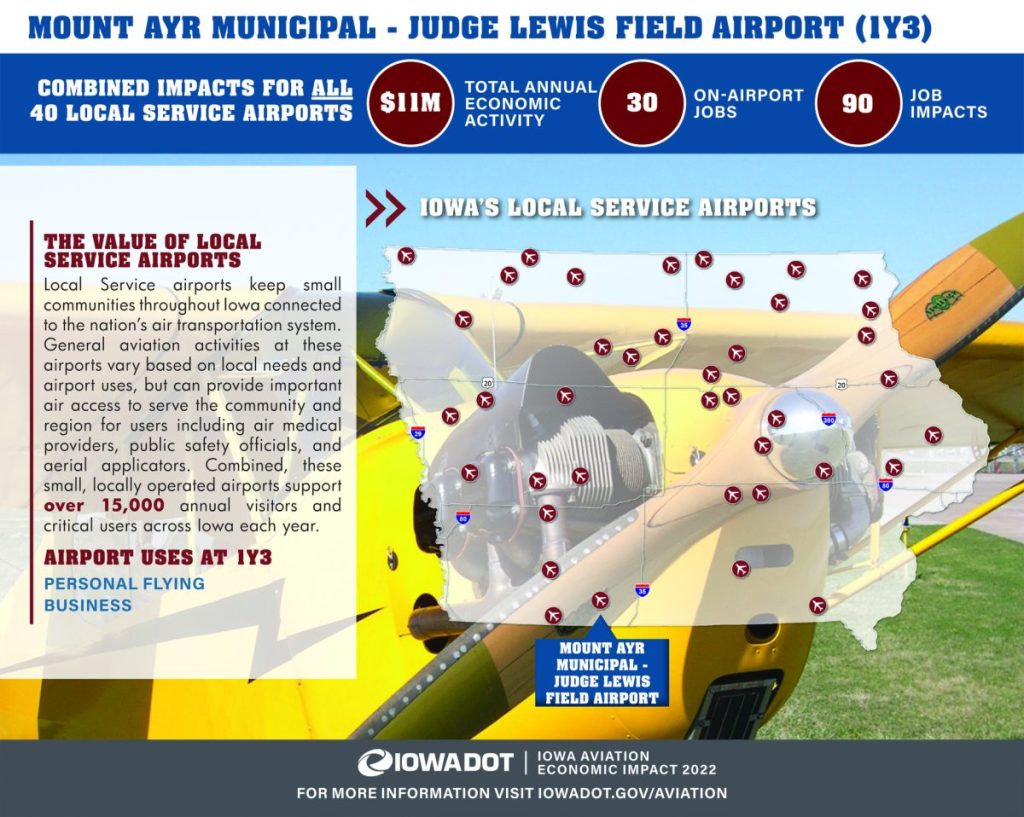
The Iowa DOT prepared the 2022 Aviation Economic Impact Report to better understand how the aviation system works and the importance of the aviation industry to the state’s economy. The Mount Ayr Municipal – Judge Lewis Field Airport provides access to individuals and businesses, meeting the aviation needs of the local community. The airport is 1 of 40 local service airports in the state.
According to a 2022 Aviation Economic Impact Report prepared by Iowa DOT, local service airports bring in roughly $11 MIL in annual economic activity combined.
Airport Decisions
After considerable discussion about the budget shortfall, potentially generating revenue, and other options, both boards voted separately about the future of the airport.
The Airport Commission was the first to vote. A motion to finish the hangar project was put forward by Adams, and was seconded by Warin, with four members voting in agreement, and Rotert voting “no.”
City council member Greene then motioned to finish hanging the airport doors and pouring concrete fittings. The motion was seconded by Murphy and unanimously approved by the council.
Administrator Wise then suggested the commission meet with the council quarterly to generate a plan going forward.