Wind ordinance explained
PROTECTED CONTENT
If you’re a current subscriber, log in below. If you would like to subscribe, please click the subscribe tab above.
Username and Password Help
Please enter your email and we will send you a password reset link.
Last year, the Ringgold County Board of Supervisors approved both wind turbine and solar ordinances to establish minimum requirements and regulation of siting, construction, operation and decommissioning of commercial energy systems.
While 1,500-2,000 feet setbacks from residences, businesses, property lines, and roadways are the industry standard, Ringgold County set larger set back distances based on resident feedback.
Wind project developers such as Steelhead need to adhere to Ringgold County’s wind energy ordinance adopted on July 24, 2023. The full ordinance can be found on the Ringgold County website at: www.ringgoldcounty.iowa.gov/departments/supervisors/county_ordinances.php
Set back distances
All wind turbines need to be set back at least 2,640 feet (one-half mile) from an adjoining property owner’s property line, unless the affected property owner waives the setback requirement by written agreement.
Turbines also need to be set back at least one-half mile from public parks or areas and the center of any roadways to protect the public right-of-way.
A set back distance of one-mile is to be observed around any County Conservation parks or wildlife areas, as well as state and federal parks or land.
Additionally, wind turbines will need to be at least one mile from the city limits of any incorporated municipality, unless the affected municipality waives the setback requirement by written agreement.
Wind turbine placement
Theoretically, a section of land is 1 square mile, and wind turbines could be located in the center of a section of land, where the four quarter sections meet.
Since a quarter section is typically made up of four 40-acre parcels, and 40 acre parcels are generally 1,320 feet across, a quarter section would be roughly one-half mile across.
While the half-mile and one-mile setbacks in the ordinance made wind project development difficult, land owner agreements can potentially affect the placement of turbines, since adjoining land owners can waive the setback requirements.
Land owner agreements
Since April of 2023, Steelhead has been working on negotiating land owner agreements and “good neighbor agreements” which has resulted in 6,000 Ringgold County acres being secured with interested land owners so far. The land campaign is anticipated to take up to three years, and Steelhead is optimistic about reaching their goal of securing at least 20 wind turbine sites.
 Wind over 60% of Iowa electricity
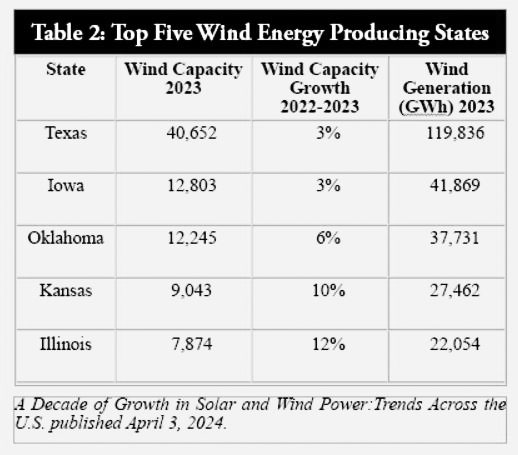
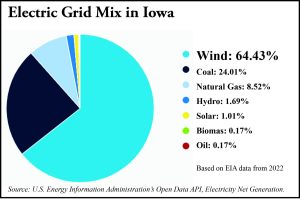
Iowa currently leads the nation with the highest percentage of electricity produced by wind, although Texas generates almost three times more wind power than the Hawkeye state. Iowa is one of only two states where wind comprises more than half of the current electricity mix. Electricity generated from wind accounted for over 60% (41,869 GWh) of Iowa’s electricity, around 55% (9,389 GWh) of South Dakota’s mix, and 22% (119,836 GWh) of Texas’ electricity last year.
Wind projects under construction, active development, and proposed projects are expected to bring Iowa over 14,700 MW in the next few years. According to the U.S. Wind Turbine Database created by the USGS Energy Resources Program, there are currently 6,481 wind turbines in Iowa.
Iowa is also among the top five states with the most wind capacity. According to a 2024 Climate Central report, “A Decade of Growth in Solar and Wind Power,” the top five states generating the most electricity from wind power in 2023 included Texas (119,836 GWh); Iowa (41,869 GWh); Oklahoma (37,731 GWh); Kansas (27,462 GWh); and Illinois (22,054 GWh). See Table 2.