Town hall talk
PROTECTED CONTENT
If you’re a current subscriber, log in below. If you would like to subscribe, please click the subscribe tab above.
Username and Password Help
Please enter your email and we will send you a password reset link.
Area legislators hold public meeting in Mount Ayr
Two area Iowa legislators appeared at a town hall for area constituents Saturday, March 29 in Mount Ayr. District 7 State Senator Tom Shipley and District 17 State Representative met with approximately 40 are residents to share their views and listen to constituent concerns.
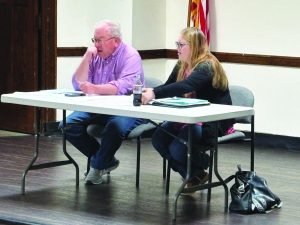
State senator Tom Shipley and state representative Devon Wood met with constituents Saturday in Mount Ayr.
Senator Shipley remarks
Shipley opened the morning discussing the legislative process, including the approaching second funnel week, which will narrow down the number of bills under consideration.
He outlined his committee schedule for the upcoming week, including education, appropriations, agriculture, transportation, judiciary, and natural resources.
He explained the Iowa Senate does not conduct hearings but allows subcommittee participation, including lobbyists and regular citizens.
Shipley stressed in the past week, the Senate passed 32 bills, with 17 passing unanimously and only six along party lines.
The senator stated several bills related to education on still on his chamber’s agenda.
State aid to schools has yet to be set for the upcoming school year, with the Senate proposing a 2 percent increase and the House advocating a 2.25 percent raise.
Schools will be required to have policies on cell phone use, with Senator Shipley advocating for parental control rather than legislative intervention. A study on the impact of various technological devices on students in schools is also being conducted.
High school athletics policies are under discussion, including making it easier for fans to pay in cash to attend games.
Shipley also highlighted potential legislation related to hunting regulations, including allowing youth to continue hunting if they don’t fill their tag during the initial season and flexibility in turkey hunting seasons for landowners.
Devon Wood remarks
Rep. Wood opened her remarks by explaining her interest in rural healthcare and broadband access in her new role as vice chair of the House economic growth and technology committees.
She talked about the emergency ground transportation program, which aims to improve coordination and resources for emergency medical services in rural areas.
Wood also addressed the shortage of rural veterinarians and the importance of having up-to-date veterinary services in rural areas to maintain community health and livestock management. She referenced a proposal for a rural vet innovation program to support large animal veterinarians. The program would provide grants for better technology and infrastructure, addressing the needs of aging veterinarians and recruiting new ones.
As did Senator Shipley, Wood addressed legislation related to education.
She explained the state aid package in the House includes a 2.25 percent increase along with additional one-time funding and transportation equity dollars that would provide an increase to state funding nearer to 3.9 percent.
Wood also explained proposed legislation that would change the way drop-out students are counted. Currently, if a former drop out returns to school but later drops out a second time, that student is counted against a district as two drop-outs. The proposal is to count a student only once.
Wood also mentioned proposed legislation that would allow disabled veterans to use their deer tags in both seasons.
Constituent input
Following nearly 40 minutes in remarks from the legislators, the floor was opened to input from the audience. The first question raised concerns about decreased funding for rural healthcare since administration and coordination of the state’s disability services will based out of Polk County beginning in July.
Senator Shipley stated that he had been told during a Zoom meeting on Friday that funding for those programs will not be tied to population.
Representative Wood added that the reorganization to behavioral health services would still provide contacts in rural communities to provide services.
Both legislators pledged to seek clarification on rural funding and share any new information that arises related to the reorganization of state services.
A second question related to deteriorating bridges not only in Ringgold County but in Iowa as a whole.
Shipley replied that the Senate has had little discussion about the bridge issue. He explained that bridge repair would need a combination of county, state, and federal money, but it’s going to take a concerted effort across the country to address the deficiencies. He added that he wouldn’t be opposed to a minor increase in the gas tax targeted for bridge repair.
A third questioner criticized Shipley for supporting Senate File 394 that rules pesticide labels issued by the U.S. Environment Protection Agency would be sufficient in warning users of a chemical’s health and safety.
She cited a recent judgment against Bayer Monsanto where a plaintiff received $2.1 billion due to their cancer attributed to glyphosate.
She accused Shipley of not protecting his constituents while simultaneously taking campaign money from Monsanto.
Shipley said the only thing SF 394 deals with is the label. He said if the label states that the chemical causes cancer, then the user can sue. But the EPA has no scientific proof that glyphosate causes cancer. He added that if anyone can provide that causation with undeniable proof, he would change his point of view.
He also blamed lawyers for seeking big paydays for bringing lawsuits against large chemical companies.
A fourth attendee questioned the purpose of a town hall meeting if those in attendance were given only 20 minutes to express their concerns.
When asked to voice those concerns, a fifth attendee addressed the school voucher issue to Representative Wood. She asked if Wood was concerned about school funding lost due to drop outs, why does she support giving school funding to private schools.
Wood replied her support of the school voucher bill three years ago was tied directly to a ten-year extension of financial incentives for school districts to share the services of certain staff positions, such as superintendent, transportation directors, business officials, and more. Those incentives, she said, were worth more to schools in her districts than potential losses due to open enrollment to private schools. She claimed had the sharing agreements not been extended, two or possibly three schools in District 17 would have closed.
Wood said she would have rather voted on the sharing agreement portion of the bill separately, but that was not an option.
Asked if there had been any discussion about repealing the voucher system, Wood replied that with the urban makeup in the legislature, a repeal is unlikely to happen.
Wood did state that she believed state aid should follow students, regardless where they enroll.
She reminded the audience that in her elementary years, she opened enrolled to attend school in Mount Ayr. She asked the audience if they felt it was right that her state aid portion should have come to Mount Ayr. Several audience members replied the distinction lay between public and private schools receiving the aid dollars.
The discussion was left unresolved as Shipley and Wood had a second town hall scheduled in Lenox within the hour.