Snapshots of History
PROTECTED CONTENT
If you’re a current subscriber, log in below. If you would like to subscribe, please click the subscribe tab above.
Username and Password Help
Please enter your email and we will send you a password reset link.
By Mike Avitt
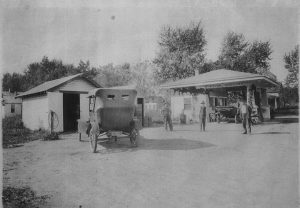
Kellerton Oil Co. in 1924.
Automobile travel was popular in the 1920s, but even more so in the 1930s.
Despite the Great Depression, motorists took to the road in record numbers. Let’s try to get a better understanding of what motorists encountered in the 1930s.
The filling station in this week’s article was built in 1922 as the Kellerton Oil Company. By 1930, most towns in Ringgold County had a filling station. But, I found some information about this station that I didn’t find with other service stations.
The (Womens) Federation of Clubs in Kellerton voted to build a restroom in connection with the station. And, indeed, I can see what appears to be an outhouse that is mostly blocked from view by the car on the left. I can see a door frame on the gable end, so I assume there is another door on the opposite end, making this outhouse a “two-holer” as I used to say.
A newspaper article in January 1923 says the ladies have nearly completed their project. Having adequate restroom facilities was important to these ladies because this filling station would make an impression on thousands of travelers over the years. This station was an early form of “rest stop.”
Last week I wrote about some tourist cabins near Redding and I found some more.
Tourist cabins and cottages were forerunners to motels. These facilities were called by different names such as tourist cabins, auto courts, motor courts, roadside parks, etc. These courts often had shade trees, water wells, picnic tables, and outhouses.
In 1933, Mr. and Mrs. Gene Huss rented the Phillips 66 station in Kellerton, along with the lunch counter and cabins that came in connection. The lunch counter may have been nothing more than cold sandwiches.
The station was located on Highway 3 which is today called Highway 2. The Huss family left in November 1933 and I never read about the cabins again. Lyle Spencer was the next operator of the station.
This was before the highway was re-routed around Kellerton. That took place in 1939.
The highway used to follow Main Street and turn north at the east end of town. The station we see this week was on the highway and is still standing today.
So, the 1930s saw highways dotted with service stations and rest stops, albeit primitive rest stops. But, the best thing that happened for motorists in the 1930s was crushed rock. By 1931, all of the highways in Ringgold County were covered with gravel. These roads were graded and culverts and bridges put in place before the spreading of rock. Highway 34 in Union County was concrete paved by 1931, so we were a little behind the rest of the world.
The first county road I found to get graveled was the Watterson (Sale Barn) Road in 1935. Of, course the gravel came from the Watterson Quarry. The gravel in the eastern half of Ringgold County came from the Grand River quarry.
By 1942, all of the highways in Ringgold County were paved with the exception of US 169 from Mount Ayr to the Missouri state line. That stretch would not get paved until 1955.
Another convenience a 1930s motorist had was all night service.
An advertisement in the August 4, 1932 Mount Ayr Record-News announced Keith Fisher’s service station at Benton would be open twenty-four hours a day beginning on August 5th. This didn’t last but other stations would later be open all night to accommodate the trucking industry before the interstate highway system became a reality.
More good news: when the 1930s began, a license to operate a motor vehicle was not required. Any old (or young) fool could jump behind the wheel and take off. This ended on January 1, 1932 when an Iowa driver’s license was required by the state. However, a two year license cost a mere twenty-five cents leaving plenty of money to buy gas or rent a cabin.