Cancer in Ringgold County – The data
PROTECTED CONTENT
If you’re a current subscriber, log in below. If you would like to subscribe, please click the subscribe tab above.
Username and Password Help
Please enter your email and we will send you a password reset link.
[This article is the second in a series examining cancer in Ringgold County. Today’s installment looks at cancer incidences specific to the county.]
As introduced last week, Dr. Mary Charlton, director of the Iowa Cancer Registry, visited Mount Ayr on August 27 as part of her organization’s 99 County Project. The goal of this project is to enhance community engagement and education around cancer prevention and control across all Iowa’s 99 counties.
Charlton’s data compared the county with state and national averages.
[In examining the data, it is important to note the distinction between the number of cases and the rates of cases.
The number signifies an actual count whereas the rate extrapolates the count to a per capita estimate. In other words, if the size and age of the populations were the same, would there be a difference in outcomes?
For example, if Ringgold County reports four cases of a new cancer, and Polk County reports four cases of the same cancer, the number of cases would be equal. The rate in Ringgold County would be much higher because of the difference in population and average age between the two counties.
In most cases, Charlton’s data compares the rates of cancer incidences due to a small number of cases recorded in the county.]
General data
Iowa has the second highest rate of new cancers in the entire nation.
Over half of Iowa’s counties (59) have a higher incidence rate than the U.S. Only one county, Buena Vista, has a rate lower than the national average.
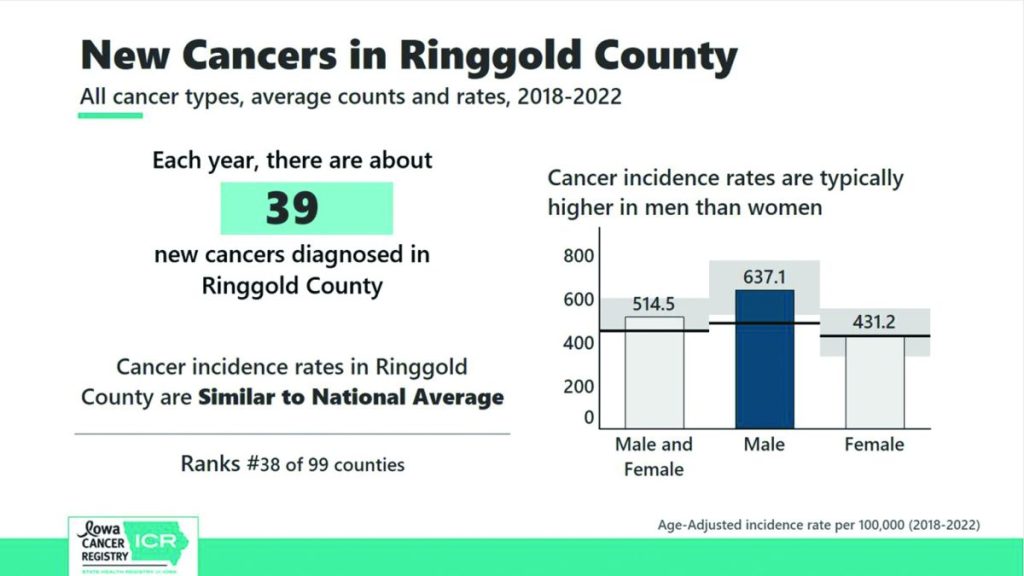
Between 2018 and 2022, Charlton reported that an average of 39 new cancers are diagnosed each year in Ringgold County. That number ranks 38th among Iowa’s 99 counties and is similar to the national average rate.
The cancer incidence rate among county males, however, is significantly higher than the national average.
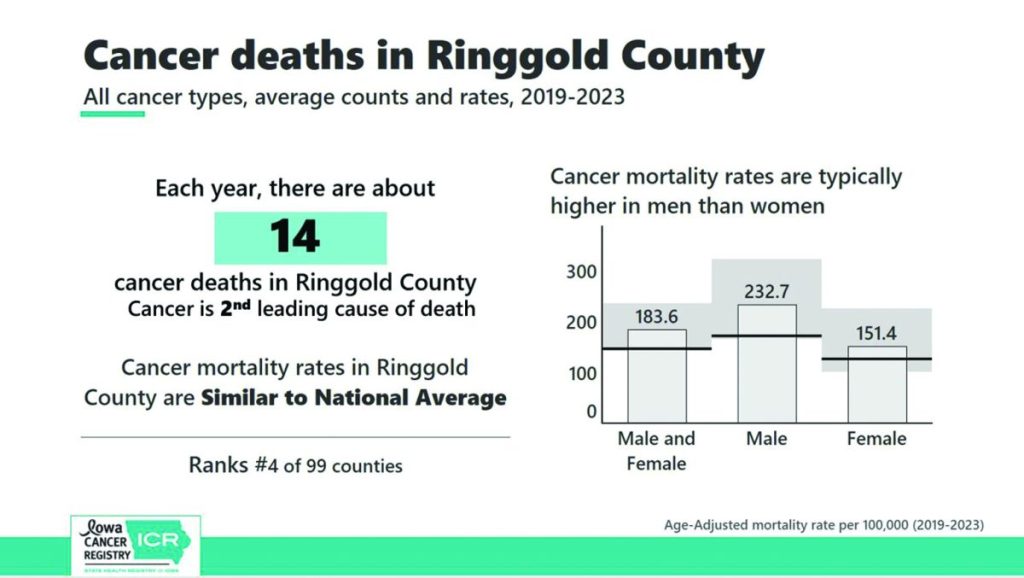
The picture changes with the average number of deaths attributed to cancer, where Ringgold County’s average of 14 deaths over that time period ranks fourth among Iowa’s 99 counties.
In fact, Charlton stated cancer is the second leading cause of death behind heart disease in the county.
Charlton also presented data on Iowa pediatric (14 and under), adolescent (15-19) and young adult (20-39) cancer incidence rates as compared to the nation.
Both the pediatric and adolescent rates are similar to the national average while the young adult rate is significantly higher than the national average.
“So that’s kind of concerning,” Charlton said, “and we see that going up in younger and younger people.”
 Most common cancers
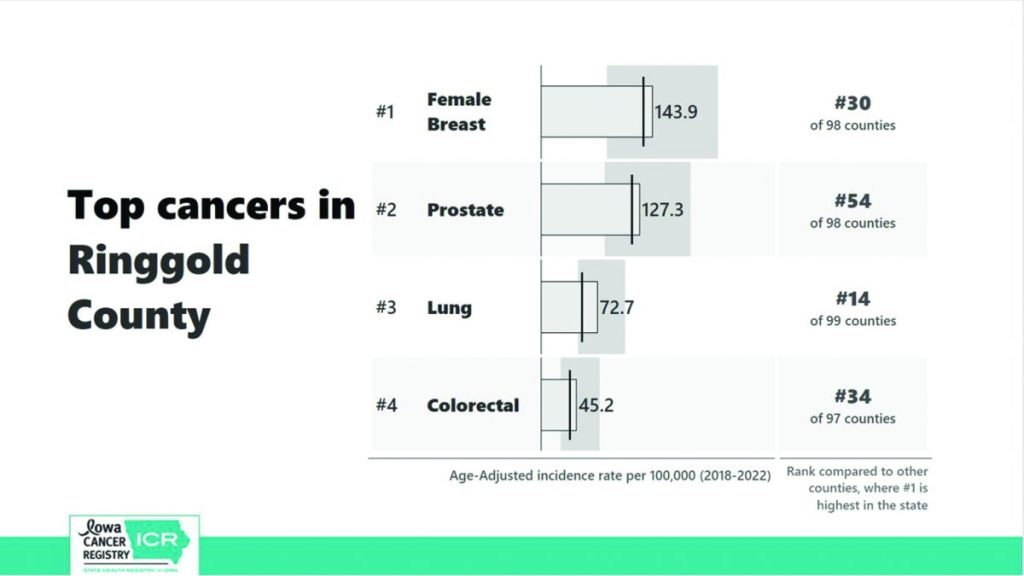
Charlton presented data on the four most common cancers reported in Ringgold County.
#1 Female breast
First on the list is female breast cancer, where new incidence rates in Ringgold County rank 30th among Iowa’s 99 counties.
Charlton repeatedly stressed that early detection is key to a favorable outcome with any cancer diagnosis. Unfortunately, 40% of breast cancer diagnoses in the county are considered “late stage,” higher than the state percentage of 31% and national percentage of 33%.
#2 Prostate
Ringgold County’s new case rate for prostate cancer is similar to the state average, but both are significantly higher than the national average.
“We just tend to have a higher prostate cancer rate here in Iowa,” Charlton said, “Our trends of prostate cancer are going up at a faster rate than the rest of the country, and that’s even after accounting for our age distribution. So it’s not driven by the fact that we’re older.”
Unlike breast cancer, only 21% of prostate cancer diagnoses are considered late stage, lower than both the state and national averages.
“The more you look for it, the more you find it,” Charlton said.
#3 Lung
As one would imagine, smoking is the leading cause of lung cancer across the board.
That fact is not good news for Iowans.
Charlton noted Iowa is one of only two states where the smoking rate is going up, and Ringgold County’s lung cancer rate is significantly higher than both the state and national averages.
Since 2016, the smoking rate in Ringgold County has increased by 22% and currently ranks fifth among Iowa’s 99 counties.
“That’s unheard of, for your smoking rate to be going up,” Charlton said. “In fact, Iowa is projected to have the highest smoking rate of all the US states by 2035 which is weird.”
A total of 82% of lung cancer diagnoses in Ringgold County come in the late stage.
“If you get diagnosed with lung cancer later, it’s pretty hard to survive a long time with that,” Charlton said, “but if they catch it on this low dose CT scan, a lot of times they can resect that and cut it out, and it’s still curable.”
Smoking and radon exposure are the top two leading causes of lung cancer, and radon moves into the top spot with non-smokers.
“Those who are exposed to those that smoke and are exposed to radon are 10 to 20 times higher risk for developing lung cancer than non smokers,” Charlton noted.
Charlton added that Iowa is the only state where the entire state is at high risk of radon exposure.
#4 Colorectal
In Ringgold County the incidence rate for colorectal cancer is higher than both the state and national averages.
As with other cancers, early diagnosis is key to successful treatment, and 66% of Ringgold County adults ages 45-75 are up-to-date with their colorectal screenings, similar to the state and national rates.
On the other hand, 72% of colorectal cancer diagnoses in Ringgold County come in the late stage, a much higher percentage than those on the state or national level.
Other factors
Charlton briefly described other factors that contribute to the county’s cancer risk.
For example, Ringgold County has a binge drinking rate of 20%, slightly lower than a state rate of 21.5%
The county has a no leisure-time physical activity rate of 30.2%, 16th highest in the state.
The county’s obesity rate is 41%, the 21st highest in Iowa, and significantly higher than both the state and national rates.
 Week 3 preview
As stated upfront, the goal of 99 County Project is to enhance community engagement and education around cancer prevention and control across all Iowa’s 99 counties.
Dr. Charlton presented the educational piece of the stated goal, but what about the prevention and control piece?
That will be the subject of the third installment of the Cancer in Ringgold County series to appear in next week’s Record-News.