Snapshots of History
PROTECTED CONTENT
If you’re a current subscriber, log in below. If you would like to subscribe, please click the subscribe tab above.
Username and Password Help
Please enter your email and we will send you a password reset link.
The second railroad line to enter Ringgold County was certainly an “odd duck.” It began in Keokuk, Iowa in the early 1870s by the Missouri, Iowa, & Nebraska Railroad. It went from Keokuk to Alexandria, Mo. and then traveled west for many miles. The line re-entered Iowa at Appanoose County and finally reached Humeston and Van Wert in 1880. Van Wert was important because it was on the soon-to-be-built Des Moines, Osceola, and Southern R.R. Around this time, the Keokuk and Western Railroad succeeded the MI&N.
Jay Gould proposed building his Wabash Railroad from Van Wert to Shenandoah, where the Wabash had a connection to Omaha, Omaha being the motive for the extension. The Chicago, Burlington, & Quincy adamantly objected Gould’s move and a compromise was reached. The Wabash and CB&Q would jointly built the Humeston & Shenandoah Railroad. Construction started in early 1881 and reached Shenandoah in November 1882.
This “branch line” was then leased to the Keokuk & Western. So, the history books refer to this section of railroad as both H&S and K&W. The CB&Q had already dominated Southern Iowa and Northern Missouri so most of the county seats had already seen the coming of the rails. The H&S created a great number of towns as it moved west.
The town of Grand River in Decatur County was created in 1881. The settlement of Westerville was two miles to the north and, no doubt, much of Westerville moved to the new town. West of Grand River the towns of Beaconsfield, Wirt and Tingley were established. The next town west was Goshen, but there was a flag stop at Kew, a community between Goshen and Tingley. Kew was a store that housed a post office and probably served as a waiting room for the train. There was no depot agent at Kew and no depot that I know.
Goshen was established a little north of the Bethel community and there was already a post office in the area named Goshen. The next towns west were Clearfield and Sharpsburg.
In 1887 the Chicago, St. Paul & Kansas City Railway laid the tracks one mile east of Goshen, creating the only railroad crossing in Ringgold County. The CStP&KC opened for traffic in 1888 and Goshen decided to move to the crossing in 1889.
In reading the Goshen column in the Ringgold Record newspaper (1889), not everyone in Goshen was onboard with the move. The correspondent stated the businesses could move to Diagonal, but the school, church, post office, and depot were going to remain in Goshen. Well, not so much.
I have read that Diagonal wanted the depot from Goshen or Kew (store building?) and they apparently got one or the other as the K&W Railroad was building side tracks at Diagonal and a depot “had been set” in July 1889. All railroad business formerly done at Goshen was being handled at Diagonal by early July 1889.
In July 1895, the H&S was entered into receivership. That’s something like bankruptcy “light” or semi-insolvency. The CB&Q took over the H&S by lease in 1896 and by deed in 1901. It was the CB&Q that changed the name of Wirt to Ellston on January 1, 1896.
Many things crippled the railroad over the years. Automobiles, highways, The Great Depression, maintenance cost, loss of mail contracts to airline companies and declining rural populations were too much for rural railroads to overcome. Service on this railroad ceased on December 30, 1945.
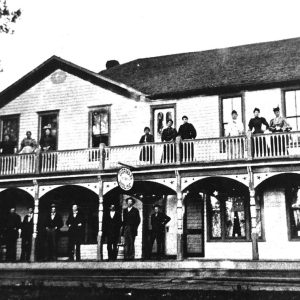
The depot in this week’s picture was dismantled in 1946 and the lumber used to build a storage facility one block north. Parts of the old H&S rail bed can still be seen in parts of Ringgold County.