Snapshots of History
PROTECTED CONTENT
If you’re a current subscriber, log in below. If you would like to subscribe, please click the subscribe tab above.
Username and Password Help
Please enter your email and we will send you a password reset link.
The Mount Ayr I grew up in is gone. I know, it’s supposed to be gone. But, I’m not happy with the replacement. I want to tell you about Mount Ayr in the years 1970 to 1973. I have a very good memory and I feel compelled to use it while I still can.
These years were my first years in Mount Ayr and I was aged 14 to 17. Previously, I had lived in Gentry, Mo. where I had limited opportunities. Mount Ayr was a brave, new world for me to convert into my own personal playground.
The Environmental Protection Agency was in its infancy and it would take Mount Ayr a few years to clean up its act. There was an empty lot where NAPA Auto Parts is now and two destroyed cars sat amongst the weeds in that lot. I believe those cars belonged to Harvey Brothers Oldsmobile & GMC. Weeds, trash, abandoned cars and vacant buildings were plentiful.
The block where Heritage Park Apartments is now was full of dilapidated houses. Some were so bad they could not be entered. Yes, my deadbeat buddies and I explored vacant houses. Marie Simpson was the only resident of that block whom I remember. She had to be removed against her will so the block could be renovated. There was a barn in the middle of that block where my hoodlum pals and I smoked cigarettes after school. It was a popular place.
Mount Ayr had a city dump north of town and customers could take their trash there during certain hours. Trash was kept in metal trash cans. For $1, Weldon Bolinger could be contracted to take your trash to the dump and return your empty trash can. Many people burned their trash in the backyard. I know of one business that burned their trash all through the 1970s. On rare occasions, a few folks would go to the city dump just to shoot rats. My stepfather Merrill Perry took my brother Mark and I to the dump to practice shooting our 20-gauge shotguns. He would throw jars to the north and we tried to hit them.
I used to go to Lucky Lanes to watch league bowling — out of boredom I guess. The bowling alley had four lanes and was a hotbed of activity on weekday evenings. One guy would bowl his frame and then run across the street to Lefty’s Club Tavern for a beer. He would return in time to bowl his next frame. The bowling teams had matching shirts. The league bowling scores were printed in the Record-News every week.
The trains were running then and my cousin Robin McFall and I put pennies on the tracks which ran behind the house Cindy Stephens lives in now. The vibration of the rolling train often knocked the pennies off the rail before or after the train passed, so we would mark the spot with a stick. Once I overlapped pennies believing the pressure would weld the pennies together. It didn’t.
In the summer of 1972, Roger Tipton and Chuck Mickael tried to teach me how to smoke. Unfortunately, we were using Joker’s (Chuck’s dad) Lucky Strikes and the venture was unsuccessful. I would have to learn another day.
There were several filling stations that sold cigarettes to minors. Cigarettes were 50 cents a pack in 1972 and most of my nefarious friends smoked. In the business community, many business owners smoked pipes or cigars. Smoking was permitted almost everywhere. Chewing tobacco was also common.
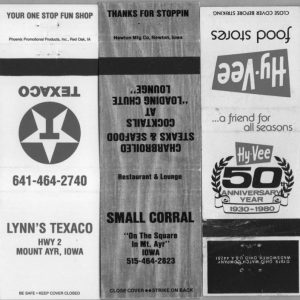
Butane lighters came around about 1972, but we used book matches because they were free. Zippo lighters were a novelty for us and we usually broke them because we couldn’t stop playing with them. Imagine that.
The swimming pool was very popular for many reasons. Girls, including lifeguard Terrie Smith, were ever present. And, yes, we had a high-diving board to endanger our lives with. We, being fearless teenage boys, had a blast with that board. It was somewhat easy to violate the rules jumping off the high board and we were often disciplined (benched). On rare occasions we would go swimming late at night after the pool closed, but a neighbor would always call the police. Spoil sport!
The police force consisted of Police Chief Avery Mickael and part time officers Clyde Brenizer and Harvey Nieman. The police car was a 1967 Chevrolet Bel Air, which was in desperate need of a tune-up. The car was black with a single red light in the center of the roof. The sheriff’s department consisted of Ringgold County Sheriff Elbert Strange and Deputy LaVerne Worthington. There was no 911 in those days. If you had an emergency, you called the sheriff’s office. After hours, you called Elbert at his home. Seriously. Elbert then called LaVerne to handle the situation. True story. More next week.