Wind turbines back on Ringgold County radar
PROTECTED CONTENT
If you’re a current subscriber, log in below. If you would like to subscribe, please click the subscribe tab above.
Username and Password Help
Please enter your email and we will send you a password reset link.
The Ringgold County Board of Supervisors learned that Steelhead Americas has secured 6,000 acres of leased land at their regular meeting Monday, October 21.
Molly Dunton, Lisa Stewart and Chris Joslin, all representatives of Steelhead, were present to update the supervisors about project development in the county.
While focusing their efforts north of Hwy 2, in the past six months they reported making headway with landowners in the northwest corner of the county.
Going into 2024, Steelhead only had one or two interested landowners. Presently, they have roughly 6,000 acres of land signed with landowners that want to participate in a potential wind energy project.
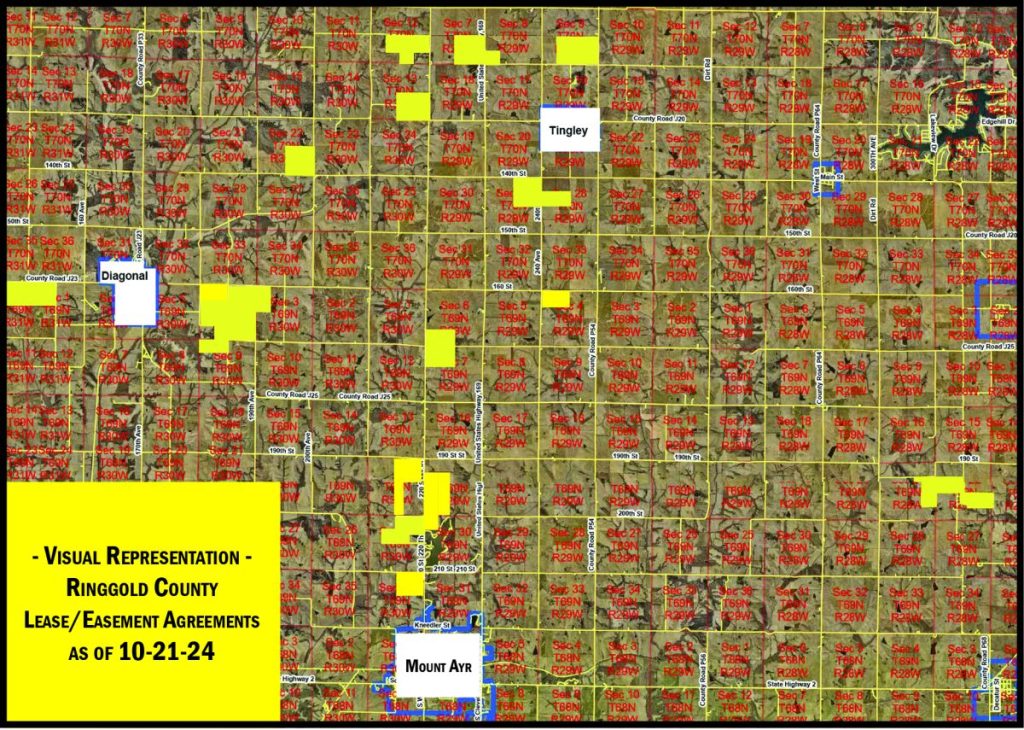
A visual representation of the recorded land lease and easement agreements between Ringgold County landowners and Steelhead Americas for potential wind energy development (shown in yellow).
While those acres are pretty spread out and some agreements still need to be recorded at the county level, they do have a couple landowners who have between 500 – 3,000 acres.
Although wind turbines will not touch all 6,000 acres, that amount of space is needed for a wind development project.
Each turbine needs at least 100 acres around it. In Iowa there are a lot of 40-acre parcels, which means that an individual landowner needs to have four or five parcels that they can sign up to hopefully get one turbine.
Wind turbines are also spaced out quite a bit from each other, and they like to stay at least 1,500 feet, if not 2,000 feet from a residence even without any regulation.
“How many of them do you have to potentially get going to make it viable to bring in the infrastructure to get them into the area,” asked Colby Holmes.
“We like to look at projects that are at least 100 megawatts, so if we’re talking about 5 megawatt turbines, that’s about 20 turbines,” explained Dunton. “The turbines that we’re looking at right now are 4.5 megawatt machines, so it might be more like 22 to 25 turbines,” stated Dunton.
“Maybe you can’t tell me this, but of the 6,000 acres, how much of that are people that live in the county or absentee landowners,” asked Steve Knapp.
According to Steelhead, approximately 90% of those landowners live in Iowa, and one is in South Carolina.
The Ringgold County Recorder’s Office had 17 wind energy lease and easement agreements filed as of Monday, September 21. Of the twelve different land owners who have signed agreements, two reside in Ringgold County, four live out of state, and the remaining six live in Iowa, but outside of the county.
Steelhead has been working on their land campaign for roughly a year.
“By signing the lease, we pay you just for the privilege of having that lease in the early years,” said Dunton, “We call it the development payment during the development period.
Landowners are getting paid for signing the agreement, and those development payments continue until the project moves into construction, which then triggers construction payments to compensate for some of the disruption to the land and farming. Once the turbine is up and spinning, that will trigger the actual turbine payment.
Depending on the final size of the turbine, which typically impacts 3/4 to 1 acre of land, landowners would receive at least $20,000 a year after installation. If a bigger turbine is installed, payments could be as high as $25,000, depending on the megawatt output.
In addition to monetary payments, Steelhead also covers the cost of installing and maintaining roads that lead to the turbine for continual access. Typically, it’s roughly a 5,600 foot road. Landowners are farmers in many cases, and the added roadway is useful because they get to park their equipment on it during muddy seasons.
“A lot of times they’re more excited about the new roads than the turbine,” stated Joslin.
Steelhead anticipates the entire process will take another five years before the project is turned on and plugged into the grid.
“There’s a lot of time to make sure that we’re designing something that folks are happy with and that’s going to be sustainable,” said Dunton.
According to a recent study completed by Steehlead, roughly half of Ringgold County is included in the wind map. Future landowner events will likely be held sometime in the spring to share more information about the potential project.