HONORING OUR VETERANS
PROTECTED CONTENT
If you’re a current subscriber, log in below. If you would like to subscribe, please click the subscribe tab above.
Username and Password Help
Please enter your email and we will send you a password reset link.
Veterans Day program honors local combat soldier
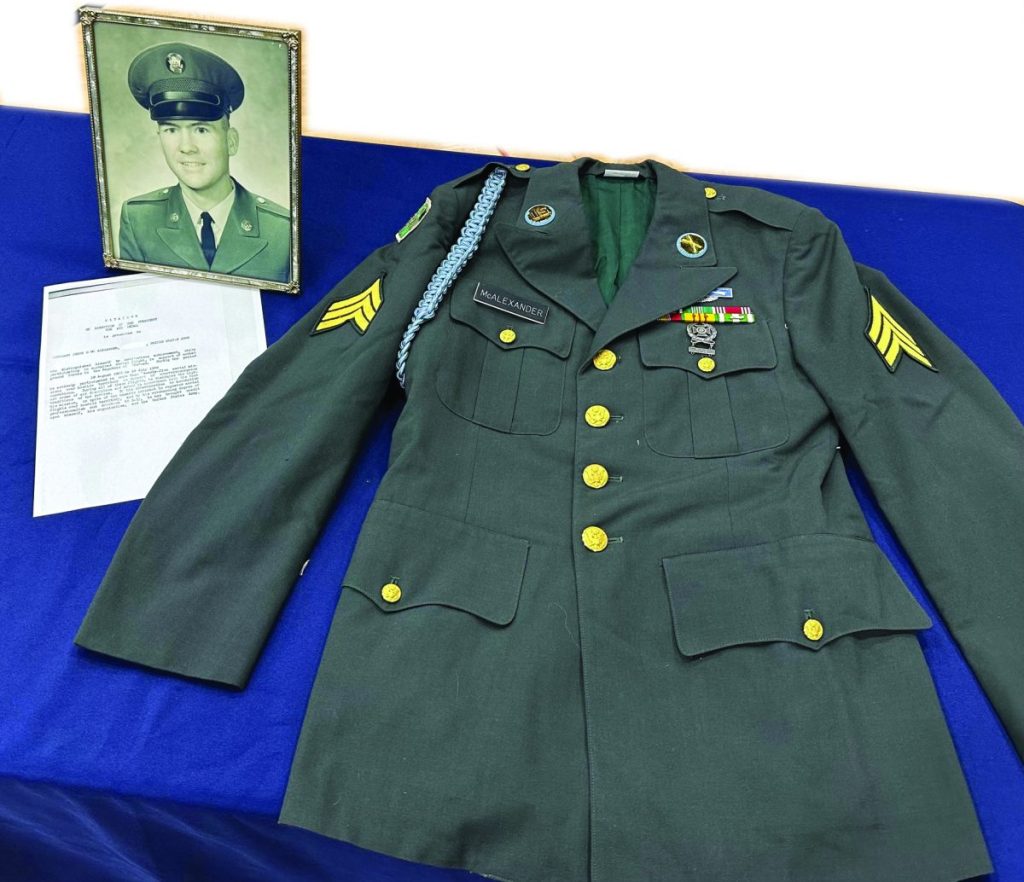
A table decorated with a picture of Jerry Dean McAlexander and his uniform displayed the various awards he received for his service to the country.
A Veterans Day celebration was held at Mount Ayr Community School Monday. National Honor Society students Jaxy Knight, Brock Shaha and Olivia Huntington gave a presentation about the experience of a local veteran, Jerry Dean McAlexander, who served in Vietnam.
Jerry’s wife, Rose, shared his medals, papers, and uniforms and Ringgold County Veterans Affairs Administrator, Hannah Rush, provided additional information and context about Jerry’s time in Vietnam with the students as part of the presentation.
Jerry was born on December 13, 1948, in Creston, IA to parents Kenneth and Virginia McAlexander. He attended Mount Ayr Community Schools and graduated in 1967. After graduation, he joined the Army on February 25, 1969.
President Richard M. Nixon, who had been elected the previous November, began withdrawing forces from Vietnam after a June 8 meeting with South Vietnam’s President Nguyen Van Thieu. However, as the first American troops were ending their time in Vietnam, others were just beginning their service.
According to the Thursday, July 31, 1969 issue of the Mount Ayr Record News, Pfc Jerry McAlexander, headed to Fort Ord, Calif. on July 23, 1969 prior to leaving for Vietnam on Saturday. Before his departure, Mr. and Mrs. Gene McAlexander and family, Mr. and Mrs. Don Johnston, Mrs. Ora McAlexander and Connie Sullivan of Humeston gathered with Mr. and Mrs. Kenneth McAlexander and family at the Mount Ayr lake Tuesday evening in honor of Jerry.
Jerry was in-country from July 26, 1969 to September 28, 1970. His discharge paperwork notes he was a part of the 1st Battalion, 14th Infantry, in the Army. A patch on the right shoulder of Jerry’s uniform indicates he was part of the 4th Infantry Division, which had the official nickname, IVY, a play on words for the Roman numeral IV. IVY League symbolized staunchness and fidelity, and the division’s motto was steadfast and loyal. Their second nickname, Iron Horse, was adopted to mark the speed and power of the division and its soldiers. These infantrymen were the ultimate weapon. They were the foot soldiers, the grunts, the men who went out and faced the enemy.
The 4th Infantry Division was deployed from Fort Lewis to Camp Anari, on flight to Vietnam, and entered combat as soon as they arrived in Vietnam, serving in-country a total of 1,534 days. Originally, they entered War Zone C of Tay-9 Providence as a part of Operation Halberd. By the time Jerry arrived in June of 1970, the 4th Infantry was thrown into Cambodia to punish the North Vietnamese Army sentries there.
The Pleiku Vietnam base was located in the Central Highlands region with neighboring Cambodia and Laos. The Central Highlands had some of the most difficult terrain. It also had the highest incidence of malaria in Vietnam. Aside from viruses, the risk of exposure to Agent Orange and other cancer-causing herbicides and welfare chemicals led to a long line of health problems for many who served in Vietnam.
Of the very few things Jerry said about his time in the service, he mentioned being a tunnel rat to his wife, Rose.
The Vietnamese dug complex tunnels to move supplies and soldiers unnoticeably. Tunnel rats were usually smaller soldiers because the tunnels were extremely narrow. They were typically equipped with standard-issued M1911 pistols, and if they were lucky, a flashlight and a few explosives.
The Viet Cong would frequently booby-trap these tunnels, filling them with grenades, venomous snakes, rats, spiders, scorpions, and, of course, ants and bats that posed a threat to them. Often, the tunnels would collapse or fill with mud.
If you look at box number 23A in Jerry’s discharge papers, you’ll find a specialty number and title.
The information indicated he served as part of a helicopter unit,in a position known as a door gunner. For the majority of the Vietnam War, the main weapon of door gunners was a machine gun, also known as an MG. Initially, the door gunner’s MG weapons were mounted on swiveling mounts. As the war went on, using bungee cords to suspend the MG became common. The bungees made the firing angles extend considerably. Door gunners were usually restrained in a helicopter with a lap belt. They also had a monkey harness worn on the torso so they could lean out of the helicopter for a better firing angle. The door gunner position was one of the least desired due to the extreme exposed position of the guy running the machine gun.
Jerry received an Air Medal and was decorated with several other medals in his service time, including an Air Service Medal, Army Good Conduct Medal, Unit Service, National Defense Ribbon, Vietnam Service Ribbons, Combat Infantry Badge, and Expert Rifleman Badge.
To earn the Air Service Medal, Jerry would have gunned down at least one enemy aircraft.
The Army Good Conduct Medal was awarded for exemplary behavior, efficiency and fidelity in active federal military service on a select basis to each soldier who did not disenfranchise himself from among his or her fellow soldiers.
The National Defense Ribbon is a decoration presented to recognize all military members who have served in active duty during a declared national emergency.
The requirements for the Combat Infantry Badge was being personally present and under hostile fire while serving in an assigned infantry or special forces primary duty in a unit actively engaged in ground combat with the enemy.
The awards on Jerry’s military jacket also include an Expert Rifleman Badge. The U.S. Army and the U.S. Marine Corps are the only military service that awards marksmanship qualification badges.
These are three different qualification levels, including Expert, which Jerry received, then Sharp Shooter, and then Marksman.
An expert was defined as a shooter that can achieve lethal effects on a threat under any circumstances, at any distance, from any position.
The Vietnam Service Ribbon with two bronze stars indicated he participated in two campaigns during the war.
Jerry was one of more than 115,000 Iowans who served in Vietnam, returning home on September 28, 1970.
After his return, he was promptly put in the reserves. He was an E1 private and exited an E5 sergeant. He continued along to annual training at the United States Army Air Corps in St. Louis, MO. He was fully discharged from his reserves obligation on February 25, 1975, and continued his life farming in Southwest Iowa.
Jerry married Rosalie Cheryl Travis on March 3, 1972, and they had four boys, Jeff, Tim, Pat, and Andy. While Jerry was fortunate to make it home to carry on a full life with his family and animals on the farm, 867 young Iowa soldiers died serving their country.More than 1.3 million Vietnamese soldiers, roughly 58,000 U.S. troops and more than 2 million civilians lost their lives during the Vietnam War.
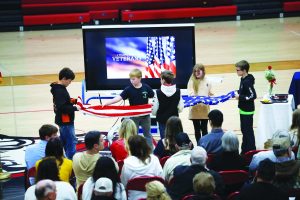
Fifth grade students from Mount Ayr Elementary School folded the flag during the Veterans Day Ceremony at the high school gym Monday.